
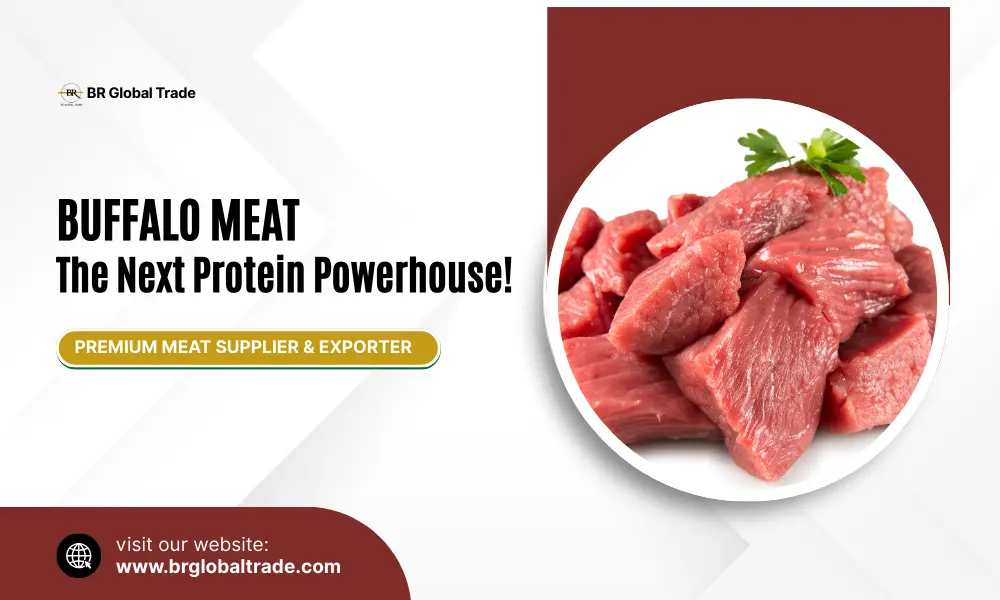

According to FAO projections, total protein consumption will increase by about 4 percent every year.
This consumer trend has resulted in a greater emphasis on sustainably produced food products like buffalo meat. The reason being
- Its reduced fat content
- And adaptability for producing large quantities of protein on a global scale.
Alongside this increase in red meat consumption globally, the increasing popularity of proteins that contain a high nutritional density will also contribute to the growth of the buffalo meat industry.
In fact, the market for buffalo meat is expected to grow from USD 4.28 billion in 2024 to USD 6.29 billion by 2032.
Buffalo meat suppliers are able to effectively bridge the gap between buffalo meat production and its distribution to consumers. So, here we are going to discuss all about the buffalo meat suppliers and how they are able to successfully fill this market demand through the use of an efficient system of quality assurance and controls.
Why Buffalo Meat Matters in Global Protein Supply
Buffalo meat’s nutritional superiority is evident in its high levels of protein and lower levels of fat and lower price point. It has a diverse consumer base with acceptance across the Middle East, Africa, and Southeast Asia with high yields creating maximum benefit from each animal.
Due to utilising feed efficiently, Buffalo have a lower environmental footprint relative to certain cattle production systems. To make it more clear, below we highlight how it is transforming global protein supply exquisitely.
- Buffalo has protein content ranging from 20 to 22 grams per 100 grams compared to most types of meats, significantly benefiting muscles in active populations.
- Buffalo also provides 1 to 2 percent less fat than other meats, thereby appealing to health-conscious diets as the global epidemic of obesity grows.
- Buffalo produces a higher carcass yield at 55 – 60 percent compared to others at 50 to 55 percent.
- Buffalo produces on average 20 percent less methane during production relative to dairy cattle.
How Buffalo Meat Suppliers Ensure Consistent Global Supply
Healthy buffalo meat suppliers from India utilise advanced refrigerated transport (reefer technology) which maintains freshness and an optimal temperature during the entire shipping process. In fact, it plays a key role in providing unmatched customer satisfaction. To make it more clear, below we highlight how buffalo meat suppliers maintains consistency globally:
Scalable Farming & Production Systems
Through their use of coordinated networks of farms, Indian frozen buffalo meat exporter yield year-round production levels that are consistent and sustained over time. A seasonal breeding methodology allows buffalo food producers to align product availability at peak demand periods, reducing the occurrence of inadequate supply even if feed prices fluctuate dramatically.
Modern Slaughterhouses & Processing Plants
The slaughterhouses used to process buffalo meat are required to be HACCP-certified, ISO-compliant, and utilise fully automated process lines that provide uniform cuts of meat. The high-tech facility design and operational processes create large-scale, safe products that can be shipped internationally.
Strong Cold Chain Infrastructure
Reefer containers are able to maintain temperatures of -18 degrees C and equipped with real-time temperature monitoring systems that provide 12 months of shelf life to buffalo meat. This technology reduces the amount of spoilage experienced during transport to faraway ports.
Export Volume Expertise
Buffalo meat suppliers have the ability to ship millions of tonnes of buffalo meat throughout the world, from both a production and processing perspective, as well as a shipping standpoint.
Also Read: frozen meat benefits vs fresh meat
Ensuring International Quality & Safety Standards
Buffalo meat exporters work under strict protocols, and Halal certification is critical. Suppliers must also have veterinary certificates confirming their products are disease-free, with verified residue testing under 0.1 ppm limits or below.
The traceability of supplier batches is tracked through blockchain technology, with respect to many advanced supply chain operations. The operations are compliant with third-party auditors, and with standard requirements established by
- The Gulf Cooperation Council (GCC),
- Association of Southeast Asian Nations (ASEAN),
- And Chinese regulations.
The certifications of frozen buffalo meat exporters in India illustrate compliance to set international standards. It allows exporters to maintain customer trust and product acceptance, even in light of increasing scrutiny from consumers. Due to these quality assurances, it is now possible to ensure safe protein to supply the ever-increasing demands for products in Asia.
Meeting Demand Through Product Diversity
To meet the tastes of a variety of cultures from Eastern curry dishes to Western grilling, buffalo meat exporters are diversifying their products. The majority of cuts are available in bulk shipments and ready-made meals.
- The frozen boneless cut is the leader in exports accounting for 60% of the business.
- After that are the front and hind quarters (representing 30% of volume) which are typically utilized by those who have traditional butcher shops.
- Offal is becoming increasingly popular in less developed areas because it is cheaper and contains more nutrients.
- Distributing products in these forms helps support the ready-to-eat food growth that is taking place primarily in urban areas.
Key Export Markets & Consumption Trends
Halal imports are increasing in the Middle East, with approximately 40% of imported volumes meeting Halal requirements competitively. In Southeast Asia, the imports are converted into sausage products, while Africa primarily considers the cost savings over importing chilled or frozen meat products. China is the largest growing market for imported Halal products, with the likelihood of growth coming from price-sensitive bulk purchases. South Asia has traditional use of Halal imported meat, adding to the growth of imported Halal product sales. Increased urbanization is leading to increased demand for processed Halal foods; however, the accepted product of buffalo meat remains the stable input in the market—hence the continued reliable supply of frozen buffalo meat from India to these markets.
Sustainability & Animal Welfare Practices
To maintain optimal feed conversion rates less than those of cattle at a 6:1 Feed Conversion Ratio (FCR) vs. 8:1 for cattle. Consequently, the emissions associated with buffalo production are considerably lower than those associated with cattle production. Consequently, buffalo farms are implementing many water-saving ranching practices, resulting in 30% less water use than cattle ranching practices, with the waste is utilized as animal feed or biogas. Buffalo slaughter plants adhere to animal welfare protocols. All buffalos are stunned before slaughter; buffalo’s stress markers at slaughter are reduced by 50% compared to other meats. The implementation of these best practices is enabling extensive optimization of each stage of production of buffalo-based protein products and meeting the increase in global demand for protein.
Challenges & Future Opportunities
The supply chain and all supporting distributors and suppliers face numerous challenges, including
- 2025 feed cost increases for buffalo producers,
- Along with changes in regulations in the ASEAN region.
- The relatively lower cold chain distribution infrastructure in many emerging markets.
- And the volatility of prices may adversely affect profitability.
However, increasing demand for lean meat has enabled growth within the sector. Investments in technology for automating processes are projected to reduce the risks associated with this market and contribute positively to frozen buffalo meat exporters in India continuing ability to meet demand in these markets.
- Supply disruptions were lessened through diversification of export sources in 2025.
- Improvements in technology (AI monitoring) enhanced yields by 10-15%.
- The increase in demand for processed food has created 20% of total market share increase.
Final Thoughts
Suppliers of buffalo meat anchor the worldwide protein supply by providing cost-effective, safe and high-yield options for growing populations. The experts will provide systems from farms through freezers to sustain international markets with projected increases of 4% in total exports in 2025.
Contact us for more information about frozen meat and products.