
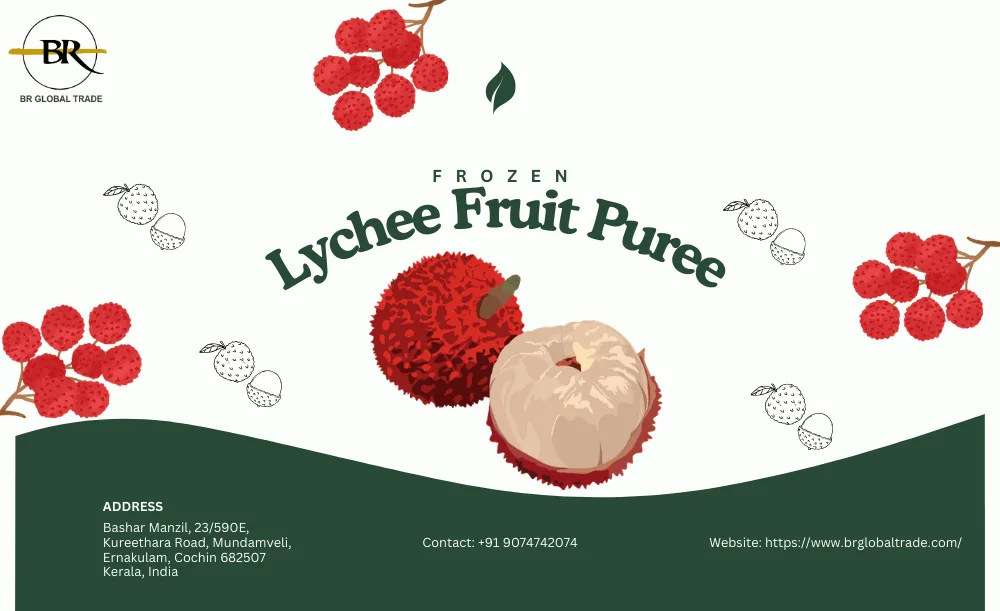

Quality sourcing with quality processing is necessary for B2B food manufacturers to create excellent quality lychee puree. Its unique delicacy and nutritional qualities are extremely fragile during processing and therefore careful sourcing and processing must take place to ensure the exotic flavor and delicacy of the fruit is preserved.
Lychee puree has many uses in produced food, including sweet and savoury products. Here in this guide, we will provide industrial buyers with key knowledge about evaluating fruit puree quality, processing standards, and its usages to make informed decisions.
Lychee Puree Fundamentals
Lychee fruit puree is made by mechanical pressing and the refinement of fresh ripe lychee, providing an even-textured product suitable for use in commercial food processing. Unlike the seasonal fresh fruit, frozen lychee puree will always retain even Brix levels, pH balance, and sensory characteristics consistently all year long.
Lychee puree is made from the fruit’s very short harvest (May to June). Therefore, it is a valuable asset for frozen fruit purees as they preserve the volatile aroma compounds and nutritional content of the fruit through extended periods of cold storage. Manufacturers typically purchase fruit puree in bulk during peak harvest time so that they have enough fruit to supply their production processes for a full 12-18 months.
Global Fruit Puree Market Context
Fruit puree is quickly becoming a popular ingredient for beverages, dairy, bakery and confectionery manufacturers who want to create exciting and unique flavours. With the growing popularity of RTD teas, yoghurts, and functional beverages, lychee puree is quickly becoming a big trend alongside passionfruit and dragonfruit.
Natural exotic flavours are being used in clean-label products (products with no added sugar), where manufacturers can use frozen puree to create an authentic fruit experience without any food preservatives.
More and more B2B buyers are stocking their inventory management systems with frozen fruit purees over fresh, perishable fruit alternatives due to the stability offered by frozen fruit purees, as opposed to the unpredictability of fresh, perishable fruits, which can be affected by the seasonality of those fruits.
Manufacturers use frozen fruit purees in large bulk quantities, usually packed in large drums, in order to produce products as close to just-in-time as possible.
Quality Foundation: Raw Material Excellence
Lychee puree with the best quality starts with the right timing of harvesting and picking of fruit that is at its peak ripeness. Vietnam is the leader in production quantity, while South Africa, Madagascar and India produce premium sensory profiles through different varieties and growth conditions.
- The desired Brix levels of lychee puree to achieve the right natural sweetness are between 16 and 20 degrees, while the bright pinkish-white colour indicates the puree is fresh.
- The pH level of the puree is between 4.2-4.8, which gives the puree a good, microbe-free state. The use of frozen fruit purees, together with their Brix and pH levels, is maintained through shock freezing in the immediate post-processing period.
- If the frozen berry purees smelled of cooking after being frozen, or were discolored or produced sediment, the manufacturer’s standards would not permit them to pass through to the consumer. Generally, the cause of these problems is a delay in harvesting prior to processing, or the fruit suffered from oxidative damage during the processing to create the puree.
Processing Precision Standards
Producing industrial lychee puree requires rigorous processing protocols to maintain the delicate flavour compounds.
- Mechanical extraction utilises fine-mesh screens that capture pulp, but remove fibrous plant material.
- The use of enzyme treatment allows a clear texture but does not hinder mouthfeel.
- The use of high-shear homogenising provides the necessary smoothness for beverage emulsifying.
- Flash pasteurisation between 85-90 degrees Celsius increases the shelf life of the finished product and preserves the volatiles better than a traditional high-temperature pasteurisation process.
- The puree is frozen immediately at -30 degrees Celsius to prevent recrystallisation damage.
- After aseptic drum filling and nitrogen purging, lychee puree is maintained frozen in food-grade stainless steel drums for shelf storage at less than -18 degrees Celsius for up to 24 months without losing sensory attributes.
Industrial Application Excellence
Manufacturers of beverages are using lychee puree throughout their higher-end products to stand out from the competition.
Within the realm of ready-to-drink (RTD) teas and functional beverages, a lychee-specific flavour profile can be achieved by using 8 – 12% of puree content to provide an authentic taste without having an artificial taste to it.
For example, mixing lychee puree into a lychee martini calls for 20 – 25% of lychee puree so that the sweetness balances against the heat from the alcoholic beverage.
In baking processes, there are no stability issues with the use of frozen fruit puree throughout the high-temperature ranges present during baking. The production of lychee danish fillings allows the final product to maintain its structural integrity, while the lychee puree in bulk provides a constant viscosity for ease of use when filling with automated depositors.
Strategic Supplier Selection Criteria
- Top-tier fruit puree suppliers provide consistent volume reliability with 20 metric tonnes or more of bulk fruit puree shipped monthly. They also supply a full suite of farm-to-processor traceability documents outlining the varietal source(s), harvest timing(s), and Brix trajectory of the product to support authentication.
- The FSSC 22000 / ISO 22000 certification of food safety management system and adherence to the internationally recognised GFSI, enable the supplier to satisfy multinational retailer-specific requirements.
- Dedicated blast-freezing warehouses, controlling cross-contamination with strawberry or mango streams, guarantee the integrity of frozen lychee puree supplied by the frozen lychee puree supplier.
- Transport excellence distinguishes premium partners from other commodity suppliers. GPS-enabled refrigerated containers provide real-time temperature monitoring. Pre-shipment Certificate of Analysis (CoA) provides evidentiary compliance for all pre-shipment and shipping parameters.
Bulk Sourcing Logistics Mastery
Industrial packaging selection is designed for optimal manufacturing integration.
- 210-L steel aseptic drums containing 200 kg of frozen lychee puree with a two-year shelf-life
- 25 kg food-grade pails suitable for small-quantity manufacturing and
- 1 tonne intermediate bulk containers (IBCs) that maximise yield for high-volume packing operations.
Protocols governing cold chain shipments dictate that product temperature does not exceed -18 °C between the time of initial blast freezing and final delivery.
India is rapidly emerging as a significant fruit puree supplier, complementing more traditional suppliers, with coastal processing hubs making India a competitive supplier of frozen fruit puree in bulk into Europe, North America and the Asia Pacific.
Regulatory Compliance Assurance
Global food safety has made detailed documentation mandatory as a result of the extensive verification process employed by clean-label products. This to substantiate their single-ingredient composition and absence of stabilisers, colours, or preservatives. The purity of lychee puree frozen naturally is also in line with numerous premium segment no-added-sugar claims.
Free-from allergen processing involves segregated production lines to ensure there is no cross-contamination with tree nuts or sulphites.
Supply Chain Optimisation Strategies
Seasonality dictates that there will be a compression of seasonal harvests (April – June), and the use of bulk fruit puree inventories should be considered before the seasonal peaks occur.
Aseptic alternatives to frozen fruit purees require 30–50% higher prices but do provide for the elimination of refrigerated transportation. Long-term offtake agreements will ensure pricing stability (+/- 5%) on an annual basis.
Market Evolution Forecast
As exotic flavours experience more market penetration globally, particularly within functional beverages, driven by the continuing premiumisation of products. Lychee puree continues to penetrate the functional beverage category with claims of an adaptogenic function, and therefore, bulk fruit purées can be used for producing limited-edition products.
Conclusion: Strategic Ingredient Mastery
Lychee puree has incomparable floral complexity that provides premium differentiation in beverages, dairy, baked goods and innovative savoury applications. The use of frozen fruit puree as a standard ingredient provides consistency of manufacturing methods and allows for the easy scaling of semi-finished products from trial to production.
Food manufacturers can develop competitive advantages through their use of supply chain partners exhibiting traceability, depth of food safety certification and the reliability of their cold chain. Having proper collaboration with frozen puree exporters will provide food manufacturers with the flexibility to formulate while minimising supply volatility.
Contact us for more information about fruit puree and pulp.
FAQs
Q: How does the lychee puree Brix level impact beverage formulation economics?
A: Higher Brix levels (18-20 degrees) will allow you to use less puree, decreasing total puree addition from 12% to 8% by weight, and reducing ingredient cost by 25% at the same time as concentrating the floral aroma. Lower Brix levels (14-16) are more suitable for yogurt applications in producing a less sweet yogurt.
Q: What is the best packaging format to maximise the economics of producing 50 tonnes/month of puree in bulk?
A: 210L aseptic steel drums produce the best yields and have a shelf life of 24 months, compared to 25kg pails. The bulk drum format of the puree will allow you to share the cold chain costs across the total amount of puree produced and minimise packaging waste.
Q: Can frozen lychee puree be used in high-heat bakery applications without impacting its flavour?
A: Frozen lychee puree has been flash pasteurised to stabilise the heat-labile aromatics during baking (180 degrees C). Specialised varieties retain 85% of their flavour after baking in comparison to the 60% retention associated with traditional frozen purees, allowing the manufacture of danishes with authentic lychee flavour.