
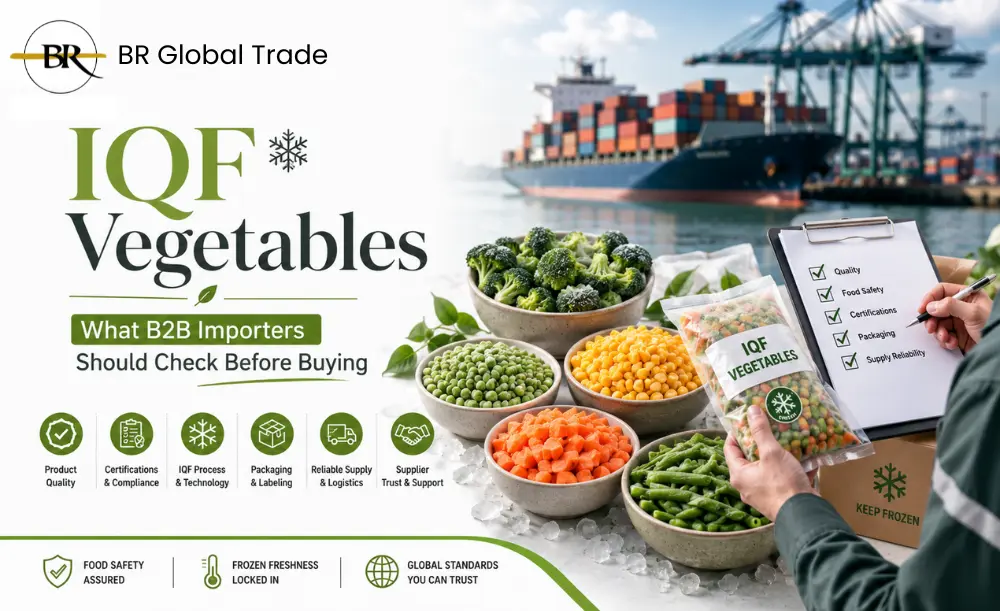

The comprehensive strategy of B2B procurement managers indicates that sourcing overseas frozen products may be simple. One of the myths of wholesale is that “frozen is frozen”. This means automatic processing of the product as if there are no differences in flavor and quality in products obtained at different processing plants.
Nevertheless, the true state of raw food sourcing suggests that even the products obtained from the IQF vegetables supplier may be of a different quality. The unscrupulous processing, variance of freezing temperature, and improper processing of the raw food after harvest can lead to considerable discrepancies between the samples and the products received in bulk.
When importing commercial food products across borders, even small variances in the production process lead to serious discrepancies in taste and quality after thawing. If you want to be certain about keeping your supply chain safe, your image and profit margin, make sure to examine the technical information behind the production.
Check the IQF Freezing Process and Cut Consistency
The main advantage of the individually quick frozen technology lies in its capability to instantly freeze the product. To understand the growing demand and market trends for IQF vegetables, read our guide on the rising demand for frozen IQF vegetables This process make it easy to avoid any kind of formation of large ice crystals within the fruits and vegetables tissues. Eventually, it plays a key role in preventing the destruction of cells. By making sure that vegetable suppliers accurately maintain temperature conditions, IQF vegetables can maintain their shape, taste, and moisture after defrosting.
One other essential aspect of the entire process is the consistency of the product. This is important for commercial kitchens and food manufacturing businesses. B2B importers should always check the cutting quality of products to ensure they are all of the same size. Non-uniformity in sizes creates problems for food service providers.
The issue with the uneven size is that small pieces become overcooked and mushy while big pieces remain cold in the center. This becomes an obstacle to proper portioning and plating. When you are looking for IQF frozen vegetables, you should always ask for particle size distribution data made for the vegetables. The data will confirm the efficiency of sorting systems in preventing the presence of small and flawed components in the final product.
Look at Blanching Quality and Color/Texture Retention
An important technical factor concerning high-quality frozen agricultural products is blanching, a procedure that consists of briefly steam or immersing products in boiling water in order to deactivate natural enzymes (i.e. peroxidase and catalase) and subsequently flash-freezing them. If an exporter does not pay enough attention to this step, then the enzymes are left active and continue to break down food even when stored at sub-zero temperatures. It leads to deterioration in product structure and taste over time.
On the contrary, over-blanching results in the cooking of the raw product, which removes the valuable water-soluble nutrients as well as some of the vibrant chlorophylls and carotenoids. The products thus obtained lack structural strength and aesthetic appeal. Importers must ask the producer for a peroxidase negative test confirmation on the production logs as proof of the effectiveness of the thermal treatment and preservation of cell walls and colors in the batch.
Understand Ice Glazing and Packaging for Bulk Orders
Ice glazing means covering frozen goods with a thin but sufficiently efficient layer of mist. This layer prevents sublimation, aging, and oxidation of products during their storage. In our work with food service distributors, we see that a lot of buyers forget about the importance of the glazing percentage. Even a 5-8% difference affects the final weight and price of the goods.
It is important that, when signing contract agreements for the delivery of IQF vegetables in bulk, the net drained weight specifications are clearly defined. Bulk packing is expected to have resistant blue food-grade polyethylene liners in five-layer carton boxes, which are resistant to enormous stacking pressure, tear-proof, and thermally insulated.
Verify Quality Standards and Certifications
International customs clearance requires proper food safety documents. When buying IQF vegetables, nobody should agree to vague compliance assurances or unsupported claims of safety. It is necessary to establish particular worldwide standards in order to confirm compliance with the IQF vegetables quality standards.
- BRCGS: Ensures that the facility operations, hygiene processes, and procedures are conducted according to the established norms.
- ISO 22000: Ensures that the principles of food safety management are applied in a systematic way.
- HACCP: Ensures that all events of potential danger happening within the production process are recorded.
- FSSAI: Guarantees compliance with the strict requirements of the agricultural products exporting country.
Instead of searching for documents online, ask certification authorities for proof of the company’s compliance with safety standards. Recent third-party audit reports should provide corrective action plans based on the audits conducted. Such reports prove the commitment of the producer to controlling sanitary conditions and improving the processes of production regularly.
Ask About Private Label and Packaging Flexibility
Multi-national grocery businesses and large-scale retail distribution networks know that their sourcing agility can be accomplished through custom wrapping solutions. The most important thing is that one has to work with the company that will be able to package private label IQF vegetables at their source. Thanks to this integration, one will avoid unnecessary repackaging costs, cut down damages caused by the handling of products and speed up the time of receiving goods.
Confirm that your production partner offers many kinds of retail packaging solutions. They have to provide anything from laminated stand-up pouches with zip locks to clear pillow packs and have good printing capabilities that will allow printing high-quality images, tracking barcodes, and nutritional food panels in different languages. Ensure that the company has effective segregation policies so that there will be no risks of cross-contamination during the custom packaging process.
Questions to Ask Before Finalizing a Supplier
Prior to executing a protracted supply agreement or transferring funds remotely, complete the following checklist with the help of the technical staff member from the supplier’s side in order to be sure of quality service:
- What amount of ice glaze do you obtain at present, and how do you regularly perform control over the net drained weight?
- Do you have the logs from the chemical lab formulated to certify the absence of peroxidase activity in the batch processed recently?
- What devices or machinery do you employ to ensure equal cuts?
- Do you have BRCGS or ISO 22000 reports from a third party for the last two production periods?
- What do you normally do in order to avoid losing the cold chain whilst transporting from the processing plant to the container area?
Choosing a Reliable IQF Vegetables Supplier
In the wholesale frozen food sourcing process, it is essential to achieve the right balance between transparency in processing, precision in technical specifications, and compliance with food safety regulations. Incoming orders for pre-cut produce should be handled with the right focus on the important parameters of the cut volume, the enzyme deactivation process, and the certified packaging solution being utilized. Working in the frozen food supply chain across different borders requires cooperation with a seasoned professional who knows the unique features of international cold chains.
BR Global Trade supplies certified IQF vegetables in bulk, with private label packaging and consistent quality standards backed by documented compliance. Contact us or email exim@brglobaltrade.com to discuss your sourcing requirements.