
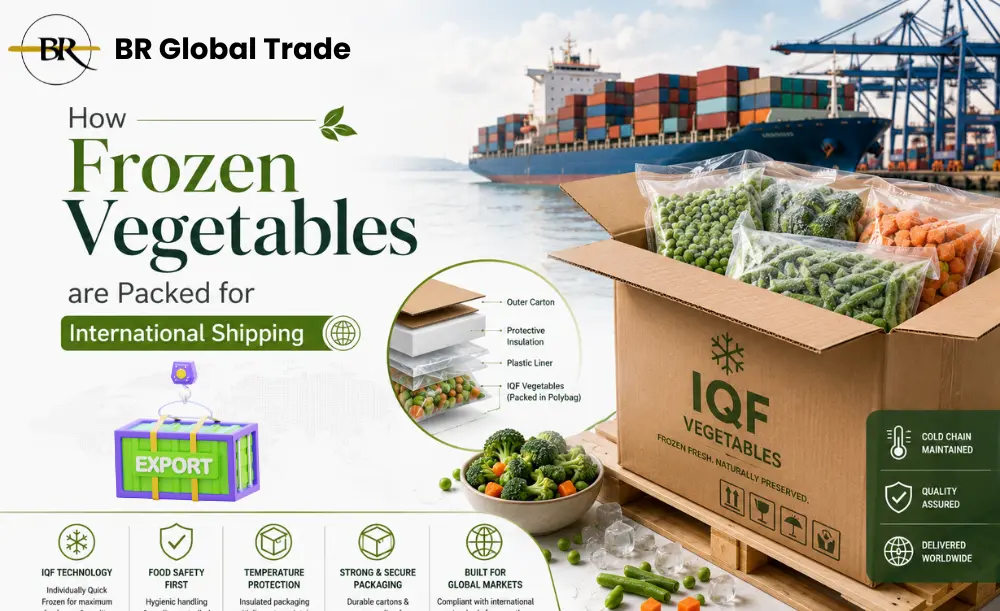

Why Packaging Matters as Much as Product Quality: Frozen food purchasers place significance on agricultural guidelines, certificates, and the Brix number while buying frozen goods. However, the best harvest can arrive at its endpoint damaged, melted, or in any other wrong condition if the packaging design does not work as intended. In logistic terms, packaging in international trade is not simply a way of containing a product but a critical source of thermal and physical protection.
If even a single weak element of the packing process fails, the product will be affected by unstable temperatures, rough handling during port-based transfer, and serious load pressure in the container. Hence, it is vital for an importer to be familiar with such aspects of logistics. In this case, it is important to work with a reliable frozen vegetable supplier in order to minimize unknown shipping risks.
Primary Packaging: Protecting the Product Itself
Primary packaging has an immediate connection to food and works as the first barrier against environmental deterioration. Food-grade, high-density polyethylene (PE) bags are commonly used in the industry. These bags survive extreme cold and wet conditions and that too without losing their form.
In order to prevent moisture loss and ice crystal formation (also known as freezer burn), processors employ specific sealing methods. One of these methods used can be either Vacuum Packaging or Modified Atmosphere Packaging (MAP), and these methods depend on the type of vegetables. MAP alters the circumstance inside the package, changing normal air to impermeable gases such as nitrogen.
The above process greatly slows down both the enzymatic process and oxidation. By saving the packing shape and avoiding any kind of chemical changes, frozen vegetables keep their shape, color, and nutrients intact during delivery.
Secondary Packaging: Cartons, Pallets, and Load Stability
Once sealed, each individual primary bag is placed into secondary packing to withstand physical pressure. Heavy-duty, corrugated fiberboard cartons serve as this layer of packaging. Due to changing moisture conditions during loading and unloading, cartons must have a high moisture-resistance rating and crush strength so that collapsing won’t occur when stacking.
Pallet forming for bulk frozen vegetables for export is a meticulous process. Cartons are carefully placed onto strong wooden or plastic pallets. Then, automatic stretch-wrapping devices cover the cargo with stretch film.
Primarily, it should be understood that pallet stacking is a technique that should provide necessary stability while ensuring optimal thermodynamic airflow. Otherwise, cargo might meet difficulties due to the blocking of the internal airways of the shipping container by cargo.
Cold Chain Packaging: Insulation and Temperature Control
The aspect of frozen food logistics that is most demanding from a technical standpoint is ensuring that the cold chain is unbroken. For the export of frozen vegetables, the standard operational requirement is to maintain a temperature of -18°C (0°F) or lower. It is achieved through specialized, advanced-temperature-controlled 40-foot containers known as reefers.
Before the containers are loaded, they are cooled down to the required degree in order to get rid of any residual ambient heat inside. The internal walls of frozen food containers are usually fitted with insulated liners to provide extra insulation against radiant heat when the containers are unloaded from ships.
In order to ensure accountability and check temperature control, data loggers are placed inside. These devices measure temperature at regular intervals throughout a shipping voyage and provide all necessary information to importers upon arrival.
Labeling and Documentation for International Compliance
Working through customs can be crucial to the success of a shipment, as compliance is a matter of properly meeting the labeling requirements on the carton itself. Thus, countries need clear labels that are not easy to wash off, ensuring traceability in any shipment. Thus, each shipment of Frozen vegetables for international buyers must have clear batch numbers, production date and expiration date, along with the country from which it comes.
Moreover, the outer carton must have the iconic symbols that are recognized universally, including ‘Keep Frozen’ and the directional arrows indicating the proper position of the carton.
Below are the essentials that is included:
- Bill of Lading
- Packing List
- Commercial Invoice
- Certificate of Analysis (CoA)
- Phytosanitary Certificates
- Specific regional health certificates
Any discrepancy between the information on the outer packaging and on the export documentation may cause delays in customs, quarantine or shipment denial.
Packaging Customization for Different Buyer Needs
International importers work in many industries, so the suppliers need to be able to provide flexible packaging solutions. Thus, a good frozen vegetables supplier should be able to go from industrial packaging to packing for food service and to retail-ready packaging.
| Industrial & Bulk Foodservice | Retail-Ready Private Label |
| Pack Size: 10 kg to 25 kg tote bags | Pack Size: 400 g to 1 kg dual-ply bags |
| Minimal exterior printing | High-definition graphics |
| Optimized for B2B defrost | Barcoded and shelf-ready |
| Maximum space efficiency | Multi-language compliance |
Typically, industrial purchasers and food producers ask for bulk products in either 10 kg or 25 kg of packaging to promote space efficiency and limit waste.
At the same time, retail distributors need private label formats that include smaller packaging options in which the bags weigh from 400 grams to 1 kg. Such packages also bear prominent branding with clear nutritional information and unique barcodes, making them market-ready.
Questions Importers Should Ask About Packaging
To protect your investment and achieve operational success, you should analyze the packaging procedures adopted by the frozen vegetables wholesale supplier before placing the order. Here is a technical list for evaluating suppliers.
- What thickness and grade of the plastic used in making bags?
- Will the carton used for packaging purposes meet the necessary needs for high-humidity transport?
- What form of stacking technology do you use to pack pallets correctly?
- Do you have independent digital thermometers in each truck?
- Can your company comply with the regulations regarding the identification of products in my country?
Reliable Packaging From a Trusted Frozen Vegetables Supplier
Acquiring the best agricultural products is merely a first step when it comes to engaging in international trade, as the most important part comes next: the ability to keep the same quality during thousands of miles of transit in the ocean.
Each phase of the packing process requires extraordinary engineering solutions and discipline in maintaining the cold chain, starting from the micron thickness of the primary food-grade bag and ending with the thermodynamic configuration of the shipping pallet.
BR Global Trade, as an experienced supplier of frozen vegetables for global buyers, eliminates all the logistical risks by using high-quality materials, effective quality control systems, and established methods of shipments. BR Global Trade provides services of transportation and packing of frozen vegetables, making sure that everything is done in line with the requirements of the cold chain and in accordance with the law.
Looking for a frozen vegetables supplier who manages the full export process? Contact BR Global Trade or email exim@brglobaltrade.com to discuss your packaging and shipping requirements