
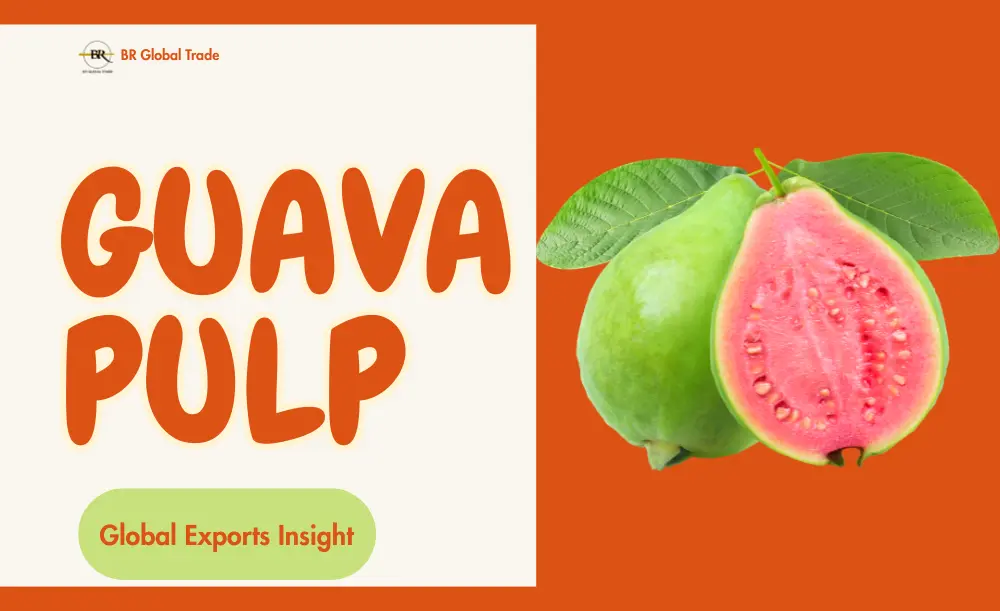

Guava fruit pulp is a vital component in food processing around the world, providing an ingredient for beverages, dairy products, baked goods, sauces, and luxury candies.
Export volumes are increasing steadily as importers in the United States, Spain and the United Arab Emirates demand reliable fruit purees for bulk supplies. This guide for exporters provides detailed information on sourcing, processing, compliance with regulatory requirements and providing the logistics necessary to compete successfully in the guava pulp export market.
Global Export Market Dynamics
There was a significant increase in the amount of guava pulp exported from July 2024 to June 2025. During that period, Vietnam, India and Colombia dominated the market for guava pulp, with a total of 24 countries exporting guava pulp. The largest volume of guava pulp was imported by U.S. manufacturers who processed the guava into both juice concentrates and dairy products.
The second largest volume of guava pulp was imported by Spanish manufacturers who processed it into premium gelato, while the volume of guava pulp consumed in the UAE was used in food service channels by restaurants and food service businesses that serve authentic tropical flavours.
The growth of processed foods supports continued growth over the long term. As food manufacturers transform from synthetic flavours to natural fruit purees, guava fruit pulp is naturally high in vitamin C and pectin, providing solutions for stabilising beverages and improving texture in baked goods without the use of additives.
Due to the need for consistency and continuity of supply, in the case of export markets, industrial buyers prefer fruit purees supplied in bulk quantities in large drums so that they can manufacture their products continuously. Industrial buyers also rely on frozen fruit purees to close the gap between seasonal supply and demand.
Raw Material Mastery
Export-quality guava pulp is produced from specially selected varieties for the best flavour. White-fleshed types produce pale to golden puree. They are perfect for clear juice, whereas pink-fleshed types are used for bright colored dairy and candy products.
Timing of the harvest is key. Exporters harvest toward ripeness (14-16 degrees Brix) and full translucency without having had any black tips on the top of the fruit. Grading of defective or blemished units occurs in the field, and the pulp should be chilled quickly to 4 degrees C to halt the enzymatic browning process.
Traceability systems document all aspects of the growing location by:
- GPS-Coordinates
- Varietal certification
- And the ripening history of the harvest from an orchard until the time it has been loaded into containers.
Today, global buyers require GPS-mapped harvests to verify authenticity to protect against fraudulent product mixing.
Processing Excellence Protocols
The leading exporters of guava pulp have implemented relatively simple, standardised processes to ensure all products are uniform.
- Automated washing removes contaminants from the field. Optical sorting identifies and removes sub-standard fruit. Mechanical destoning removes hard seeds that have the potential to damage downstream processing equipment.
- Flash pasteurisation occurs at 88-92 degrees C for a sufficient amount of time to balance the destruction of microbiological contaminants and the retention of flavour in the guava.
- Cooling occurs in multiple steps, from the time of pasteurisation until the fruit puree reaches its final temperature of 4 degrees C. This prevents cooking notes from developing due to the heat. IQF blast freezing preserves the edible portion of all guava pulp by rapidly cooling the slabs of guava pulp to -35 degrees C.
- Aseptic drum filling combines fresh guava puree (steam sterilised, 210-litre stainless drum) and nitrogen gas into the same container. Pressure releases prevent the discharge of liquid while the drum is travelling by ocean freight for transoceanic transportation. Guava pulp retains 95% of the sensory characteristics for 24 months from the date of production.
Bulk Supply Logistics Infrastructure
Utilisation of scalable packaging increases integration within your organisation:
- A 210L aseptic drum provides 200kg net of Guava Fruit Puree, delivering maximum usage to continuous fillers. A 25kg Block Frozen Pail will support pilot production, while a 1MT IBC will minimise handling for large-scale processors.
- Cold Chain orchestration ensures a -18°C temperature hold from the blast tunnel through refrigerated shipping. GPS Data Loggers will provide real-time alerts, and pre-arrival container precooling will eliminate thermal shock. Frozen Fruit Puree will arrive at production without any acclimation delays.
- Through the use of pre-cleared documentation packages, FOB operations in Mumbai/Chennai provide for the streamlined customs clearance process:
- Phytosanitary certificates
- Certificate of origin
- CoA with NABL lab verification
- FSSAI license
- Bill of Lading Temperature Declaration
Flexible MOQs allow trial orders of 5MT to full 20′ refrigerated loads of 18MT. Brix adjustments and colour matching can be made to meet the specifications of multinational brands.
If you are looking for a frozen fruit pulp supplier, explore our products and feel free to schedule a meeting with us.
Quality Assurance Framework
Global food safety harmonisation is pushing exporters to get compliance from all food safety authorities, including
- FSSAI,
- ISO 22000,
- HACCP
- And other certification/registration portfolios.
This helps them to access premium destination markets. Multinational retailer audits require FSSC 22000, and at times ensure SQF Level 3 meets it.
Clean label verifications ensure no added sugars dominate North America and Europe, are created by single ingredients without stabilisers, colours or preservatives in their composition, supported by no-added-sugar claims from guava pulp.
Third-party inspections conducted by SGS and Bureau Veritas are completed prior to loading to verify the quantities or counts are correct, glaze uniformity and conformity to specified parameters. The zero-defect quality assurance protocols in place eliminate the risk of rejection due to 98% first-pass customs clearance.
Product Customisation Capabilities
Guava pulp allows numerous types of products to be made. White flesh guava will give consumers a neutral gold base for products made with clear beverages and white chocolate truffles; pink flesh guava provides visual impact for consumers in layered yoghurts, gelato also swirled with fruit syrup.
Brix can be standardised for product formulations between 10 and 18 or any number in between.
- 10-12°: Ice cream inclusions, sorbets
- 13-15°: Juice blends, cocktail mixes
- 16-18°: Confectionery centers, reductions
Organic certification yields a 25% price premium when sold to Whole Foods and through EU natural channels. Non-GMO claims meet Asian regulatory requirements, while Kosher and Halal certification expand the list of potential buyers for dairy products in the Middle East.
Risk Mitigation Strategies
Seasonal harvesting for fruit purees in August to October creates a need for strategic bulk fruit pure inventory. Our diversified orchard contracts from across the country can help minimise exposure to weather disruptions during harvest periods; additionally, our frozen fruit puree will remain usable for 18 months post-processing. Our supply chain redundancy scheme allows us to have multiple facilities for processing fruit purees, thereby avoiding single-point failure.
Strategic Export Destinations
- The United States is the largest market for fruit juice concentrate and dairy applications, with more than 15,000 MT being consumed annually.
- Spain is the second-largest market for premium gelato manufacturers, and to them, the pinkish flesh colour of guava will be attractive.
- The United Arab Emirates (UAE) is expected to see its food service industries grow rapidly from the use of authentic beverage ingredients.
- Additionally, Latin America has emerged as a potential market opportunity, with Mexico and Brazil turning towards using guava pectins in their processing operations.
- The Netherlands is acting as a re-export hub, distributing fruit purees to the EU via private-label programs.
Conclusion: Export Excellence Formula
Exporters of guava pulp have become successful through strong partnerships with quality growers, advanced processing technologies, strict adherence to quality standards, and an efficient global cold chain process. The use of large 55-gallon (210 L) barrels allows exporters to create consistent final products throughout the entire supply chain. Also, the use of frozen guava pulp allows for uniformity in finished products.
Customers who use certified suppliers can validate their suppliers’ claims, enjoy greater customisation of products based on customer requirements, and differentiate their source product from those of other suppliers. Exporters investing across the complete supply chain see long-term sustainable prices and significant market differentiation in premium food manufacturing globally.
FAQs
Q: How do Exporters maintain consistent Brix levels throughout the seasons?
A: Exporters use multi-varietal orchard agreements to ensure that fruit is harvested at the appropriate time based on actual brix readings measured by refractometers. When the guava pulp has been removed from the fruit, the pulp will be blended at different stages to achieve the appropriate target brix level (13-15) while accounting for variations in the raw fruit.
Q: What is the most efficient packaging option for producing beverage products with 50 metric tons of guava juice each month?
A: Using 55-gallon (210 lt) aseptic steel drums allows exporters to recover 98% of the weight of the product as opposed to using 25 kg pails (8 times for handling). When the guava puree is in a bulk format, the cold chain costs to move the product are spread over the maximum amount of product.
Q: Can frozen guava pulp be used in high-temperature baking processes without losing its flavour?
A: Flash pasteurising guava pulp allows the high-temperature stable esters to create baked products at baking temperatures of 190°C. Premium guava pulp, when used in baked products, withholds 88% of the sensory volatiles post-baking as opposed to 65% from standard guava pulp, and provides a guava-flavoured pastry.