
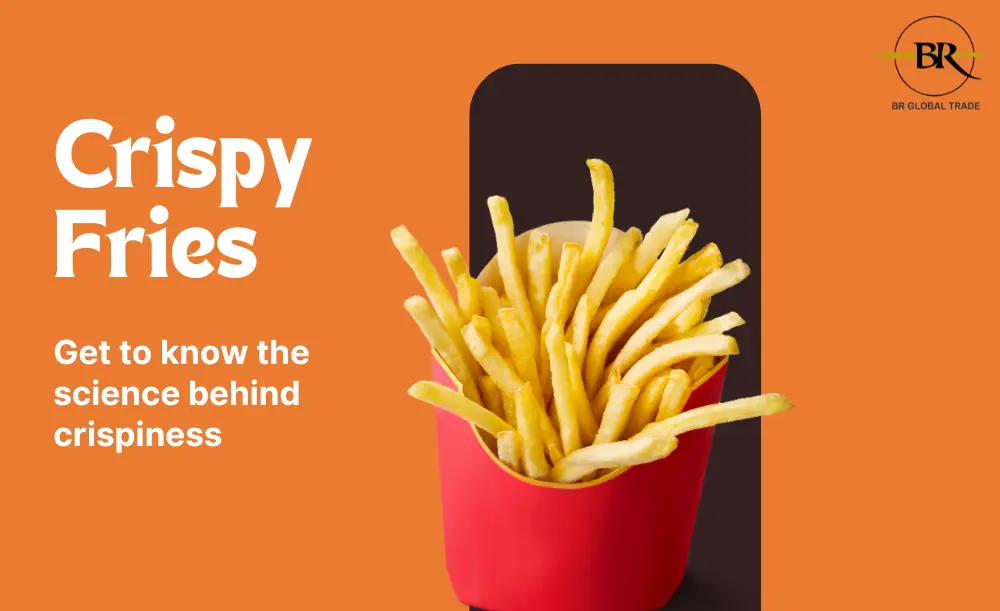

To create the right level of crispiness, frozen french fries manufacturers remove moisture in a way that preserves the texture of the inside and helps to preserve their integrity during transportation. It is done by pre-frying the frozen fries before freezing it to create a protective layer. Not only this, the IQF method is also used for freezing immediately after pre-frying as it allows for rapid freezing and no development of large ice crystals in the starch, resulting in a light, fluffy interior.
Why Crispiness Matters in French Fries
When done correctly, you get frozen french fries that are crunchy on the outside, fluffy on the inside, and still remain in this condition even after being shipped or reheated.
For the reasons given, alternating crispy and fluffy french fries create consumer satisfaction. French fries that deliver this satisfying combination of crunch and fluff promote
- Repeat purchases from consumers,
- Helping maintain brand consistency for chains operating from one location to multiple locations.
On the other hand, frozen french fries that do not properly achieve the desired crispiness will be subjected to several unique challenges faced by importers and buyers such as
- Extended supply lines resulting in varying temperatures,
- Poor storage conditions,
- And varying conditions when re-frying frozen french fries.
It is important to note that the creation of a consistent and dependable level of crispiness in a frozen french fry is the result of precision in manufacturing procedures. It begins with the selection of the correct potato variety and manufacturer through to the finished packaging of the freezing systems.
Understanding Crispiness: The Science Behind It
The appeal of frozen French fries relies on creating a state with maximum surface area through the drying of moisture in conjunction with the formation of a rigid starch structure that enables the fries to hold together. The main factors affecting this drying include:
- Moisture Content and Evaporation – All other factors being equal, an excess of moisture on the surface of the potato will result in steaming instead of crisping. Suppliers incorporate the removal of excess surface moisture via strategic post-blanching so as to achieve maximum evaporation during final frying.
- Starch Structure and Gelatinization – When potatoes undergo par-frying at high temperatures, they form gelatinous starches that are then extruded during re-heating to create a crisply baked potato. They must be able to withstand the transition of being par-fried to deep-fried without losing their texture.
- Surface Texture Role – The microscopic roughness generated from the application of coatings and par-frying adds to the volume of air at the surface area of the potato. This increases the amount of air trapped inside the crust of the potato, thus increasing the amount of crunch produced.
There are many wholesale french fries suppliers who ensure every aspect of the above steps are followed to maintain crispiness all through to the destination. But, to maintain this crispiness the first step is to get the right potatoes and we have it sorted for you below.
Potato Selection: The First Step Toward Crisp Fries
The primary consideration by Indian frozen French fries suppliers and exporters for selecting potatoes for frying is their level of firmness, achieved through careful choice of suppliers that will yield consistent results when fried.
- Potatoes with High Dry Matter – The two types of potatoes that yield the firmest fries when fried are Russet Burbank and Atlantic potatoes. Both of these potatoes contain between 20 and 24 percent dry matter. These products also contain significantly less oil than potatoes with an 18% dry matter content (less than 15%).
- Low Reducing Sugar Content – Potatoes with a reduced sugar concentration lower than 0.2% will not produce dark spots on fried potato products. So, if a batch contains too much reducing sugar, it will cause inconsistent browning of the fried product.
- Increasing Consistency by Controlling Source of Potatoes – Contract farming is the primary method of ensuring consistency when growing potatoes for frying. Potatoes grown under contract are assured of Uniformity in size (minimum length of 70mm) and Stability (seasonal variability),
The results from this pre-processing check will yield an estimated 25% impact on the fried product’s final texture.
Precise Cut and Blanching Methods:
The process of blanching potatoes before frying is also important in preparing them for defining a standard size, to remove excess moisture, and to prepare the starch matrix for proper frying. Also, by using precision cutting blades to cut potatoes into strips of defined dimensions, suppliers will ensure even penetration of heat throughout the potato.
- Blanch to remove Excess Sugars – Hot water (70-90° Celsius) for one to two minutes will remove excess surface sugars and deactivate enzymes in potatoes, and the potatoes must then be cooled. If the blanching process is not done properly, the potato will be either soggy or will lack internal fluffiness after frying.
- Temperature and Time Control – Par-frying will allow you to develop a thin, outer “shell” that is easy to cook within a final frying method. Par-frying will also add flavor to par-fried potatoes without using the entire amount of oil needed for cooking the potatoes through full immersion.
Par-Frying: Building the Crispy Outer Layer
As a result of cooking with heat, the moisture in the fries will evaporate, which will then begin the browning process and replace the water with oil, creating a barrier from moisture. Premium oil suppliers continuously filter their oil to eliminate off-flavors.
- Oil Temperature and Duration – The addition of a light coating of starch or dextrin (1-2% of the weight of the total product) can increase crunchiness and increase the time between cooking and eating by 10-15 minutes after frying.
- Crust Formation Mechanism – During heating, water evaporates and browning begins. Oil replaces water, creating a barrier and exporters continuously filter oils in order to eliminate off-flavors.
- Coatings for Enhanced Crispiness – Coatings used to increase crispiness are made from light starches or dextrins (1-2% by weight). It adds crunch and extends time by 10-15 minutes post-frying.
Rapid Freezing Technology: Locking in Texture
Individually Quick Frozen (IQF) technology locks in moisture by halting all enzymatic activity immediately after frying and maintains the structure of fry product through the reheating process even after months spent in transit.
- IQF Process Explained – Fried products pass through a tunnel that freezes them at a temperature of -35 to -40°C in mere seconds, creating small ice crystals. Block freezing, however, creates larger ice crystals that can be 30% more damaging to the fry product’s texture than small ice crystals.
- Minimizing Ice Crystal Damage – Rapidly cooling fried products preserves the moisture gradient and ensures fluffy interiors. Frozen fry products are stored at a steady state of -18°C by suppliers.
- Frozen Fry Storage and Transit Temperature Control – In the case of frozen fry products, all temperature fluctuations are logged using data loggers with a tolerance of ±2°C, and any deviation from the designated range will result in freezer burn and a decrease in crispness yield.
- Packaging, Storage, and Export Handling – Fried products must be packaged with great care to ensure they reach the end user in a crisp and crispy condition. All cold chain management of frozen fry products must be followed from factory to fryer through global supply chains.
- Packaging to Resist Moisture – Multiple layers of food-grade liners and vacuum-sealed cartons prevent moisture ingress, while multi-layer films can be used to extend shelf life to 24 months.
- Cold Chain Management – Reefer containers have continuous temperature logs maintained at the appropriate temperature of -18°C. This is where exporters optimize the stuffing of containers so they do not develop the “hot spots” commonly associated with improper loading and/or insulation.
Impact of Fluctuations and Cooking Instructions
When thawing frozen French fries, multiple re-freezing can lead to associated crispiness loss. Clearly defined fry temperatures of 175° to 190°C will give you maximum crispiness after frying for a minimum of 3 to 4 minutes.
- Quality Testing/Cross Quality Checking – As a reliable frozen potato fries exporter in India, one needs to perform extensive testing during the manufacturing process to ensure product stability and quality consistency. They test various temperature conditions to simulate end user frying conditions.
- Fry & Hold Time Testing – Fry samples at specified temperatures are evaluated for 10-15 minutes to determine crispness. Any sample with a score higher than 8/10 is acceptable.
- Color, Texture, Instrumental Testing – Golden colour is determined using a spectrophotometer and a texture analysis tester assesses force of fracture.
- Compliance & Customer Feedback – Microbial safety is certified through HACCP/ISO Testing lab. With the help of the customer feedback, business processes become 98% stable in terms of supplying the respective product.
- Final Frying Conditions for Buyers – To achieve maximum crispiness when frying frozen french fries, end users must duplicate the conditions of the manufacturing process.
- Frying at the Correct Temperature And Time – For maximum expansion of French fries, fry in a single layer at a temperature of 175° to 190°C for a minimum of 3 to 4 minutes on each side.
- Load Size & Agitation – Do not over-fry as over-frying results in steaming. So, gently shake or move the French fries around during frying.
- Common Mistakes – Excessive load size or inadequate fry temperature leads to soggy french fries. Double frying will add approximately 20% to the hold-time and ensure that the delivery is adequate as needed.
Conclusion: Crispiness Is a Result of Process, Not Chance
Crisp, light, and perfect fries are the result of controlled raw materials, proper IQF quality-control freezing, and rigid logistics. Fry manufacturers that offer the same consistent performance globally utilize professional French fries wholesale suppliers that have gone through these processes.
Importers must ensure they get the most reliable, high-margin product by requesting process transparency, test sampling, and certificates of analysis (COA) when they buy french fries in bulk.