
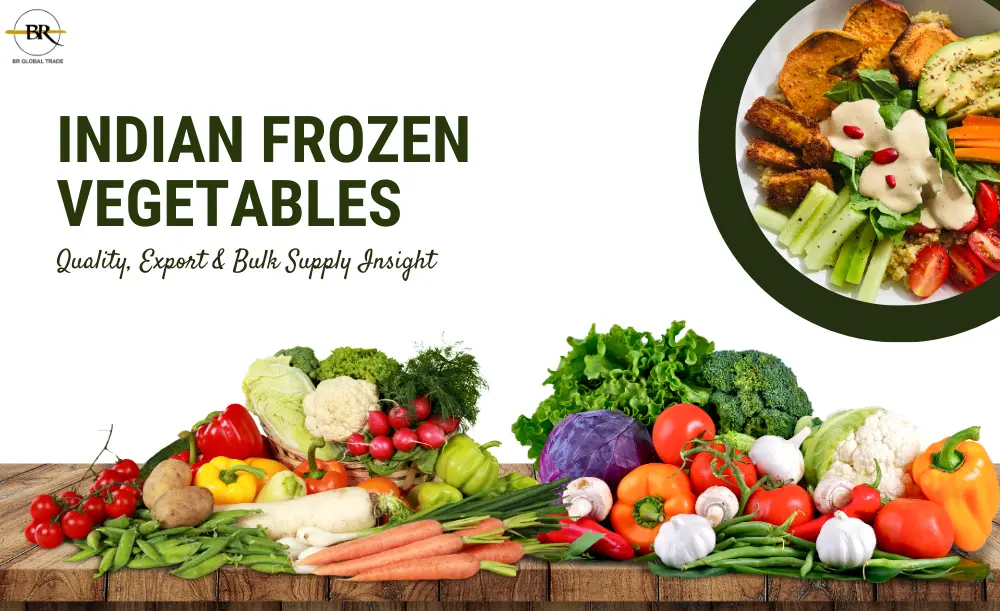

As a result of its large-scale agricultural production across 13 states and advanced IQF processing capabilities, India has developed an extremely competitive position in today’s global frozen vegetable market.
Agricultural production in India allows for year-round availability of optimum nutrition, texture, and convenience when using bulk frozen vegetable formats that supply foodservice chains, retail packers, and industrial processors globally.
Here we are going to help you get complete understanding regarding quality and export compliance through scalable production capabilities.
Indian Frozen Vegetable Ecosystem
When frozen Indian vegetables are harvested at their peak maturity, they are quickly frozen using Individual Quick-Freezing (IQF) technology. Individual quick-freeze is the primary method for freezing food for customers seeking to preserve the original texture of an individual piece.
Block frozen is an alternative method for freezing food that is used for commodity-based applications that do not require portion control when frozen. Because of India’s year-round growing conditions and multiple growing regions, frozen vegetable suppliers can guarantee year-round availability despite the seasonality of specific crops. This gives global buyers the security of being able to purchase frozen vegetables without worrying about product waste.
Export Compliance Certification Framework
Frozen vegetable export compliance certification framework based on widely accepted international standards provides market access to premium segments:
- FSSAI License (the Indian equivalent of FSIS meat and poultry), which sets the minimum standard for food exported from India, and APEDA Registration is required before qualifying for an agricultural export.
- The HACCP System serves to establish critical control points throughout the process from harvest to packaging. ISO 22000 is used to assess the effectiveness of the overall food safety system. BRC Global Standard is an internationally accepted food safety standard that addresses the needs of the food retailers in Europe.
- Halal certification opens up foodservice Channels to Middle Eastern customers who require other requirements of Ritual Compliance. The EU Organic Seal can be marketed at a 25%-40% premium as a part of the Natural Product Marketing Segment.
Processing facilities implement rigorous protocols:
- Automated washing eliminates pesticides and field contaminants
- Metal detectors capture fragments >1.5mm
- Online vision systems reject discoloration
- Continuous belt freezers achieve −35°C core temperatures
More than 50 new testing labs and container depots have been added to the infrastructure recently. This reduces transit time exposure and increases the speed of certification processing.
IQF Processing Excellence
- The IQF technology has transformed the preservation of product quality. Using cryogenically cooled nitrogen tunnels, the whole vegetables travel through the tunnel for 3 to 5 minutes before they reach −196°C temperatures.
- After reaching these temperatures, the vegetables freeze before clumping together and losing their integrity for portioning into standardized foodservice dispensers.
- The processing of blanching varies from one vegetable to another. For instance, peas require approximately 60 seconds and 95°C, spinach requires 30 seconds and 85°C, and okra requires 90 seconds and 90°C for the inactivation of any enzymes without degrading the texture of the vegetable.
- The packaging for bulk frozen vegetables consists of heavy moisture-vapor proof cartons that contain either 10-20 kg poly-lined bags. The export pallet configurations are standardized at 1 metric ton (MT) to allow for maximum density for stuffing containers.
- The significant difference between block frozen vegetables and IQF frozen vegetables is that when block frozen, the edges of the vegetables are severely damaged due to the block’s structure after being sawed.
- Additionally, the thawing rate of blocked frozen vegetables is variable. However, IQF frozen vegetables offer reliable cooking performance and consistent appearance, which is why importers only use IQF in frozen vegetable import/export transactions.
Bulk Supply Infrastructure
Indian exporters offer a wide range of frozen vegetable assortments to accommodate different bulk frozen vegetable specifications.
Minimum Order Quantities (MOQs) have no restrictions for frozen vegetable trials (5 MT) through full-container-loads (FCLs) of 25 MT. Private labeling is available for all buyers’ specifications (count size, glaze percentage, carton print specifications).
Cold chain orchestration integrates:
- Processing zone −25°C blast freezers
- Inland −18°C warehousing (500,000+ MT capacity)
- Port −20°C reefer yards
- GPS-enabled reefer vessels
- Destination precooling protocols
FOB operations streamline documentation:
- APEDA health certificate
- Phytosanitary clearance
- CoA with parameter verification
- FSSAI export license
- Bill of lading temperature declaration
Containers enabled mixing various vegetables with the goal of maximizing efficiency from how much space can be used to load. The frozen vegetable supplier is working with an LCL consolidated company to help importers trial import frozen vegetables in order to reduce their landed costs.
Strategic Export Destinations
- The Middle East is the leading import region for frozen vegetables from India with UAE and Saudi Arabia being the fastest growing importers with the rapid expansion of hotel chains and supermarkets. Green peas account for 60% of sales in the frozen vegetable category because of their use in making authentic biryani, which has a more established market share than other vegetables.
- Europe focuses on the UK, Germany, and the Netherlands as key ethnic retail channels where imported frozen vegetables are desired because of their authenticity. Okra and spinach are two of the highest-priced frozen vegetables because of their specific culinary applications.
- Growth in North America is tied primarily to the growth of ethnic supermarkets in the U.S. and independent foodservice distributors in Canada. Cauliflower florets are also experiencing growth because of trends away from eating carbohydrates.
- Countries in Southeast Asia import frozen vegetables from India, while in Africa, Nigeria and Egypt are fast-growing wholesale markets for the Indian exporter.
- Frozen vegetable export data clearly shows that India has a leadership position globally with over 250,000 metric tonnes of frozen peas, sweet corn and okra being exported from India and competing successfully with frozen vegetable exports from China, Belgium and Egypt.
Partner Selection Framework
Global food service buyers look to purchase frozen vegetables from certified suppliers who can demonstrate:
- Audit ready documentation, including annual BRC/SQF inspection and certification validity
- Sample evaluation programs that demonstrate cooking quality, color fastness, and flavour authenticity before making a commercial commitment
- Cold chain transparency through web portal access to real-time temperature history, container GPS, and customs status
- Consistent lead times averaging 25 – 35 days FOB with a < 5% incidence of delay
- Open and consistent communication to reduce specification drift and to confirm production schedule
- Shelf life validation of frozen vegetables via accelerated stability studies help build long-term confidence
Market Evolution Trajectory
As global convenience food production continues to accelerate, frozen vegetable exports from India will increase due to labour shortages and increase the value of ready-to-cook frozen vegetables. The expansion of retail private label programs favour bulk frozen vegetable prices reaching a consistent price point compared to fluctuating prices for fresh vegetables.
The appeal of vegetable positioning has increased with the use of frozen, shelf-stable, “fresh” vegetables that have been frozen at their freshness point, containing significantly more Vitamin C than fresh alternatives that are weeks old and out of season. The trend toward lower-carbohydrate diets has resulted in an increase in demand for products such as riced cauliflower and vegetable blends with low-carb characteristics.
Conclusion: Strategic Supply Partnership
The abundant growth of vegetables in India, combined with the advanced technology used in their manufacturing, and their certification, gives frozen vegetable suppliers access to a large supply of high-quality frozen vegetables delivered in bulk by food service, retail and industrial channels. The frozen vegetable suppliers with leadership in the use of individually quick frozen (IQF) technology will have the ability to maintain better quality during frozen storage and continue to produce the same quality of product through the trial period to produce the same quantity for multinational purchasers.
Frozen vegetable exporters control compliance to all international regulations and reduce the risk of their products being rejected at borders, while ensuring that frozen vegetable shelf life provides assurances of consistent production. Employing suppliers of frozen vegetables demonstrating audit transparency, flexible specification and reliable logistics will allow strategic purchasers to establish long-term partnership relationships with their suppliers of frozen vegetables.
Frequently Asked Questions
Q: Why is Individual Quick Freeze (IQF) processing superior to traditional freezing methods in preserving the quality of frozen vegetables?
A: With an IQF process, the time needed to achieve −40°C at the core of a vegetable is about 4 minutes. Thus, there is less chance for the formation of large ice crystals that will cause the rupture of the cell wall. The block frozen method produces damage to vegetables due to ice bridging, which results in texture loss, and less moisture during cooking. IQF vegetables retain 92% moisture, while block frozen vegetables retain only 78%.
Q: Which certifications do frozen vegetable importers need to look for when evaluating frozen vegetable suppliers from India?
A: Some of the major certifications for Indian suppliers include the BRC Global Standard for Retail Compliance, ISO 22000 for Food Safety Management, HACCP for Critical Control Verification, and FSSAI/APEDA for export licensing. Halal certification would also allow suppliers to access the Middle Eastern market. In the EU natural food segments, organic certification can earn suppliers a 30% premium.
Q: Can Indian exporters provide customized vegetable blends (i.e. mixes of vegetables) and packaging for specific market needs?
A: Indian exporters have sophisticated packaging capabilities to produce custom blends like mixed vegetable blends containing peas, carrots, corn, and/or green beans in an infinite number of combinations, ensuring that the mixture meets the specifications of their customers.