
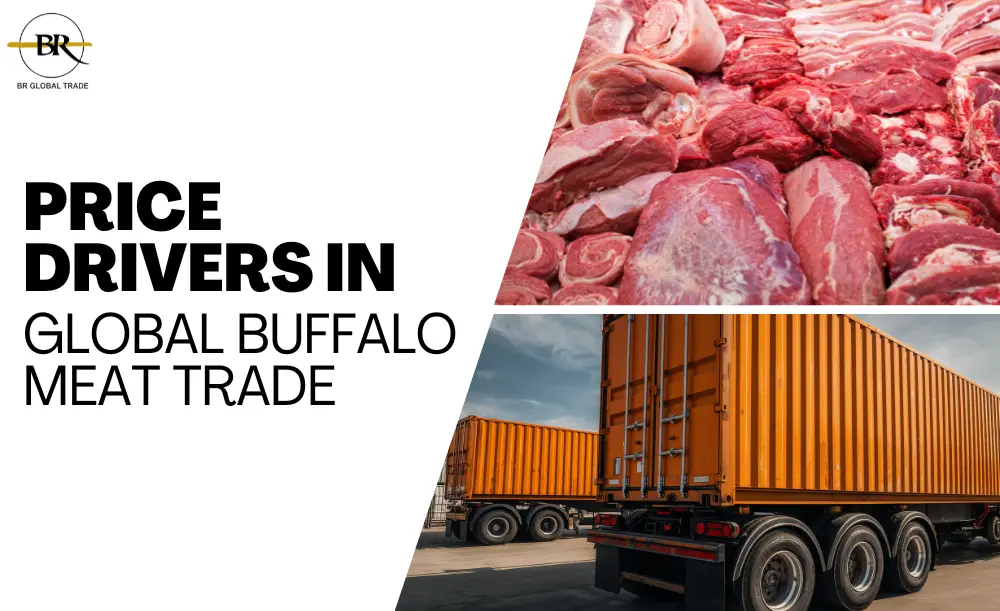

The world trade in buffalo meat generates billions of dollars each year, with India dominating a significant part of it. Producers benefit from this stability and predictability in income, while importers can manage their cost of goods sold by knowing how to interpret these critical export price dynamics for competitive forms of protein.
Global Market Snapshot
- India has become a leader in the buffalo meat export market, with exports of more than 1.2 million metric tonnes of buffalo meat each year.
- In addition, while Pakistan, Egypt and Southeast Asia may meet some of the regional demand for buffalo meat, none of them have the scale or cost structure that India possesses.
- Leading importers of buffalo meat are Vietnam, Malaysia, Iraq and the Gulf Cooperation Council (GCC) countries of Saudi Arabia and the United Arab Emirates (UAE).
- The consumption patterns of each of these markets establishes a benchmark price for the export of buffalo meat.
- Middle Eastern buyers pay premiums for certified products and Southeast Asian importers focus on volume and price.
As a result, buyers typically enter into longer-term contracts that reflect the economics of a specific destination and help to provide predictable flows of trade through time.
Buffalo Meat Supply and Demand Forces
Supply and demand for buffalo meat are driven by both livestock cycles and the slaughter capacity available. When the dairy industry is at peak production, there are fewer animals available for slaughter, creating competition among a variety of users of the raw material. Consequently, putting upward pressure on spot market prices, because exporters are aggressively bidding for the limited supply of animals that exist during this period.
The slaughter windows following the milking process create spikes in the supply of buffalo meat and significantly reduce the pressures on pricing. By strategically stockpiling products, exporters can deliver the product consistently to their customers throughout the lean production cycles. It helps them maintain consistent pricing for buffalo meat in the export market.
The growing middle class in Asia and the Middle East will continue to create strong demand for imports. Many consumers in price-sensitive markets require competitive baseline pricing to ensure adequate volume, while quality-conscious purchasers will pay modest premiums for guaranteed quality supply. This inherent tension will create stable pricing corridors giving rise to classic supply-and-demand pricing conditions.
Regulatory Pricing Barriers
Buffalo meat trade regulations create huge market access barriers as well as embedded compliance cost flows directly into export pricing.
Additionally, strict SPS conditions requiring foot-and-mouth-disease-free status will prevent exports to high-value destination markets and will require exporters to substantially invest in veterinary infrastructure and biosecurity to gain access.
Import standard fragmentation greatly increases costs. EU traceability protocols are significantly different from Middle Eastern documentation packages and require different lab validation for The U.S. These various requirements will enable the global buffalo meat trade pricing structure to rise.
Halal Certification Economics
The Halal buffalo meat export industry has opened up the global market by approximately 40%, while also requiring complete segregation of facilities, ritual slaughter oversight, continuous audit trails, and annual re-certification. This will elevate commodity meat traders from being just another commodity to being premium-quality suppliers.
- Middle eastern importers are increasingly willing to pay a 5-10% premium over baseline prices for verification of halal integrity, as they recognize the importance that both religious compliance and quality assurance play in these purchases.
- The certification costs incurred by halal buffalo meat exporters are quickly recovered through exclusive access to the market, which is not available to their uncertified competitors.
- Routine maintenance of the facility requires facility modifications and documentation systems or inspector travel.
- Halal buffalo meat exporters systematically build these premiums into their pricing while at the same time keeping their pricing competitive with their volume.
Macro-Economic Price Pressures
Currency-related price fluctuations can create significant macro economic pressures for halal buffalo meat exporters. Higher fuel prices for transportation will increase the logistics surcharge that exporters pass on to the importer.
Contractual terms and conditions will fluctuate as the rupee experiences devaluation providing an instant pricing advantage over alternatives in the Australian or Brazilian meat markets. The advantage gained through rapid depreciation of the rupee will be reversed overnight with appreciation of the rupee resulting in renegotiation of contracts in place.
Container shipping disruptions, routing changes through the Red Sea, and cyclical global inflation will result in increased freight rates globally. This in turn will lead to unified price movement across the global buffalo meat supply chain regardless of individual exporters’ efficiencies.
Regional Price Differentiation
Buffalo meat produced in India is priced considerably lower, between 25-35% compared to meat from Brazil and Australia, due to both the structure of production costs and the supply of domestic feed sources. This pricing advantage allows buffalo meat to hold its position as a significant player in exports, even under challenging conditions in the global meat market.
The Middle Eastern markets have a ready-to-export halal premium. They are priced higher than the commodity prices in Southeast Asia. Vietnam has a goal of maximizing tonnage at a baseline price, while GCC contracts include both volume commitments and documented quality bonuses. Proximity provides India with a natural freight cost advantage to reach the nearest markets.
Exporter Volatility Strategies
Producers can lock in both volume and price with forward contracts (6, 12, or 18 months), allowing them to avoid the volatility associated with the spot market. For institutional importers, forward contracts are the preferred mechanism for managing their budget and providing long-term assurances of supply.
Total portfolios: Geographically Diversified, Middle Eastern hala premium balances the high-volume flow of Southeast Asia, creating a smoothing effect on revenues due to the amount of demand seasonality.
IQF processing and precision cutting convert commodity blocks into a premium product, commanding 20-40% more than the standard frozen price. The gradual shift of exporters toward variable-priced products, while maintaining the strategy of providing essential base-load volumes, creates a more sustainable business model.
Emerging Market Trends
- New emerging economies such as Africa are accelerating at an increasing rate compared to the traditional Asian low-priced imports of protein.
- The net effect creates additional baseline pricing pressure that is partially offset due to increasingly long shipping times.
- The global consumption of protein continues to grow in a long-term upward trajectory.
- Sustainability certification follows the halal model where premium prices reflect verifiable antibiotic-free production and carbon-controlled supply chains.
- The EU and premium GCC buyers typically pay 10 to 15% over standard prices for validated provenance. Through the use of blockchain technology, documentation fraud can be eliminated and premiums are justified through the assurance of quality.
- Smart contracts help automate the verification of compliance with trade regulations when exporting buffalo meat across diverse importing standards, progressively lowering transaction overhead and increasing pricing transparency.
Conclusion: Strategic Price Mastery
The pricing of global buffalo meat is determined by complex interactions of the supply and demand fundamentals of buffalo meat, importation compliance costs for buffalo meat, halal export premiums, and macroeconomic volatility. Exporters will use a combination of forward contracting, geographical diversification, and adding value when processing to endure these circumstances.
Buyers will have a comparative advantage when they understand the underlying drivers of their business and can negotiate responsibly based on the different destinations, specifications, and periods in time.
As such, establishing prices through forward pricing discipline, balanced portfolio of the marketplace, and a premium certification methodology will allow for the development of a sustainable profit in a continually evolving market.
FAQs
Q: What key factors enable Indian buffalo meat to remain consistently priced below prevailing international bovine meat market rates?
A: The major reasons are the structural production efficiencies gained from lower feed costs, unused dairy cull animals, and domestic grain security, which give Indian buffalo producers a price advantage of 25-35% compared to specialized meat operations.
Q: What is the usual price difference associated with sourcing from halal-certified suppliers?
A: Verified halal suppliers have an average price premium of 5-10% over the baseline rate for premium-quality, verified halal supply chains. Due to the market access to halal-certified products that other suppliers do not have, the cost of certifying halal supply chains is typically recouped within 3-6 months after certification.
Q: Can a buffalo meat exporter fully eliminate exposure to price fluctuations in the market?
A: No, but smart buffalo meat operators keep price swings low (under 5% yearly) with simple strategies like locked price, spread out markets, book out profit