
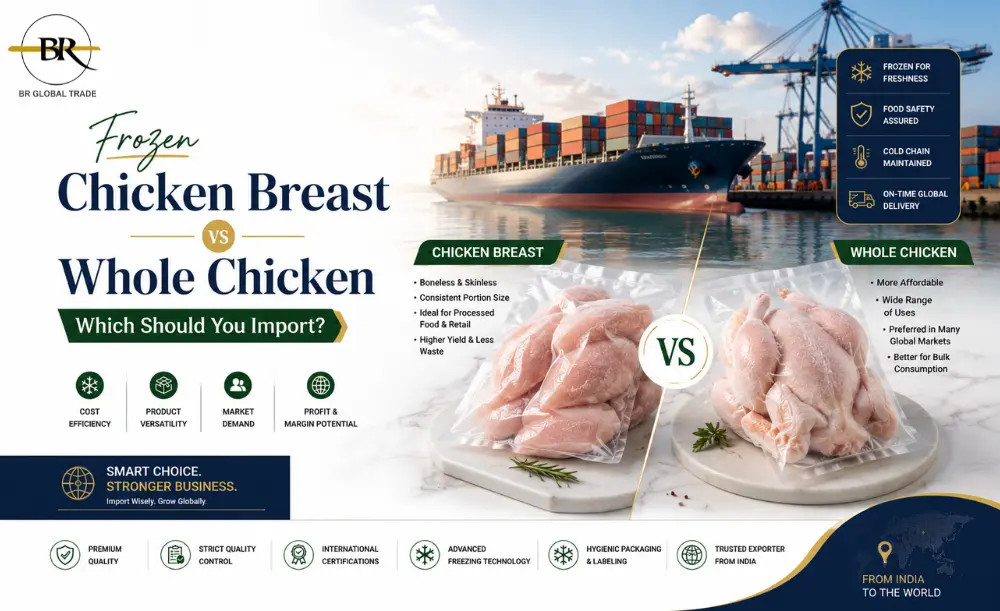

Choosing between frozen chicken breast and whole chicken starts with what your customers buy and how your business prepares or sells the product. The lower price per purchased kilogram may not give you the lower cost per saleable portion.
This guide helps importers, wholesalers, distributors and foodservice buyers compare product specifications, usable yield, local preparation and storage needs before requesting an export quotation.
When frozen chicken breast fits the order
Breast meat can suit buyers who need white meat for portioning, food manufacturing or foodservice. Confirm whether the offer is bone-in or boneless, skin-on or skinless, and whether it is a whole breast, breast fillet or another specified cut. These descriptions affect preparation and the usable product you receive.
If portion consistency matters, agree a piece-weight range, size tolerances and the sampling or inspection method. Frozen breast meat does not automatically arrive in identical sizes. Ask whether additional trimming or portion cutting is needed for your intended use.
Boneless breast can reduce deboning work when compared with purchasing whole birds for that purpose. It can still require thawing, trimming, handling and cooking. Plan the operation around the exact specification rather than the product name alone.
When whole frozen chicken fits the order
Whole chicken can suit retail sales of whole birds, wholesalers serving customers who use several cuts, or operations equipped to cut and portion birds locally. Agree the bird-weight range, dressing specification, whether giblets are included, and the number of birds and net weight per carton.
The whole frozen chicken discussed here is a processed carcass. Your local work may involve thawing, cutting, deboning or cooking, depending on the business. Slaughtering is not the destination preparation step for this product.
A whole bird provides breast meat and other cuts. If you only need breast, account for how you will sell or use the remaining parts. If customers buy whole birds, judge the offer against that saleable format rather than assuming the bones are waste. Confirm the value and handling requirements of each output before choosing the order format.
Compare cost on the same usable-output basis
Texas A&M AgriLife’s chicken cost and yield guide explains why purchase price, preparation and yield should be assessed together. Compare products against the output your business actually needs: a whole retail bird, saleable raw portions or cooked portions.
For a cutting or foodservice operation, a useful calculation is:
Cost per usable kilogram = (landed batch cost + local preparation costs − justified credits for other saleable outputs) ÷ usable kilograms for the intended output.
Keep the costing boundary consistent. Record which freight, clearance, duties, local transport, storage, labour and waste costs are included, and avoid counting any item twice. Do not compare raw kilograms from one format with cooked kilograms from the other.
Illustration using assumed figures: if landed batch cost is USD 1,000, local preparation costs USD 150 and the batch produces 800 usable kilograms, the cost is USD 1,150 ÷ 800 = approximately USD 1.44 per usable kilogram, before any additional costs outside that calculation. These assumed figures demonstrate the arithmetic; they are not a BR Global Trade quotation or an expected product yield.
Use a sample trial or documented results from the proposed specification for your own calculation. The USDA Food Buying Guide distinguishes purchased products from usable servings and notes that cooking yield varies with the product and cooking method. Its published averages are planning references, not a guarantee for an export order.
Compare specifications and packing before comparing prices
Ask both offers to state the details that matter to your operation:
- Product description, cut, bone and skin requirements, and raw or cooked status.
- Piece or bird weights, tolerances and the agreed quality specification.
- Any added solution or ingredients, and the declared net weight and measurement basis.
- Freezing method, pack format, carton dimensions, net carton weight and pallet arrangements.
- Production dates, declared shelf life, storage instructions and the remaining shelf life required on arrival.
- Origin, facility details, traceability information and documents required for the destination.
Confirm the freezing method separately from the packaging. IQF describes individually frozen pieces; IWP describes individual wrapping or packs. Ask what is available for the selected product and origin.
Compare freight using actual carton dimensions, palletisation, payload limits and the carrier’s loading plan. Breast meat and whole birds do not have one universal container-loading advantage.
Both formats need a controlled cold chain
Raw frozen breast and whole chicken both require safe handling. FoodSafety.gov’s food-safety guidance explains that freezing does not destroy harmful germs and that raw poultry must be kept separate from ready-to-eat food. Cutting the product in advance does not remove those requirements.
Confirm the applicable product storage temperature, transport settings, monitoring records and receiving procedure with the supplier and importer. The same guidance gives 0°F (−18°C) or below as general freezer guidance; commercial shipment requirements must follow the agreed product specification and applicable destination rules.
Plan thawing, preparation space and handling capacity for the selected format. Agree how temperature deviations, damaged cartons or other delivery discrepancies will be documented and assessed under the order terms.
Check origin and destination eligibility for the exact supply
BR Global Trade supplies halal frozen chicken breast and whole chicken for importers and distributors in Africa, the Middle East, South Asia and CIS. Available sourcing origins include Brazil, Argentina, Poland, Thailand, China, the USA and India. Product availability and origin-to-destination eligibility are confirmed for the proposed order.
Check the supplying facility, certifying body’s destination recognition, applicable halal and health documents, labelling and any required permits. General accreditation alone does not establish acceptance for every market. For Saudi Arabia and UAE enquiries, refer to our halal chicken import compliance guide for the main checks to discuss before ordering.
Prepare a quote request that lets you compare both formats
Send your destination country and port, product list, quantity for each item, preferred origin, weight range, cut specification, packaging and required documents. Explain whether you will sell whole birds, sell portions or use the chicken in foodservice or manufacturing. This helps make the comparison relevant to your business.
Ask for separate production or preparation, dispatch and estimated sea-transit timings. Transit can change with vessel schedules, congestion, weather, route changes, blockades, conflict and other disruptions. Confirm the schedule and responsibilities in the quotation and order confirmation.
Use our bulk frozen chicken buying guide to prepare the order details, then request a chicken export quote. You can include breast meat, whole chicken and other required products in the same enquiry, with quantities listed separately.
FAQ
Q: Is boneless chicken breast always better value than whole chicken?
A: The better value depends on the product you sell or use, preparation costs and usable output. Compare quotations against the same output and include the value of other cuts from whole birds where relevant. Use results from the proposed specification rather than a fixed assumed yield.
Q: Which whole-chicken specifications should I confirm before ordering?
A: Confirm the dressing specification, bird-weight range and tolerances, whether giblets are included, net carton weight, birds per carton, pack format and required documents. Match these details to your customers’ requirements and the way you will sell or prepare the product.
Q: How can I order breast meat suitable for consistent portions?
A: Agree the piece-weight range, size tolerances, trimming, bone and skin requirements, and the sampling or inspection method. Confirm whether you need natural fillets or a separately portioned specification. The available options must be checked for the chosen origin and product; uniform portions are not automatic.
Q: Can both formats be supplied halal for our market?
A: BR Global Trade supplies halal frozen chicken, subject to the selected product’s availability and destination requirements. Confirm the origin, facility eligibility, recognised certification body and shipment documents for the exact order, whether it is for breast meat or whole birds.
Q: What details are needed for a quotation, and can I request several products?
A: Send the destination country and port, product names, quantity per item, preferred origin, cut or bird-weight specification, packing, required documents and schedule. You can request multiple products together. Available specifications, minimum order quantities and shipment options are confirmed against the proposed order.