
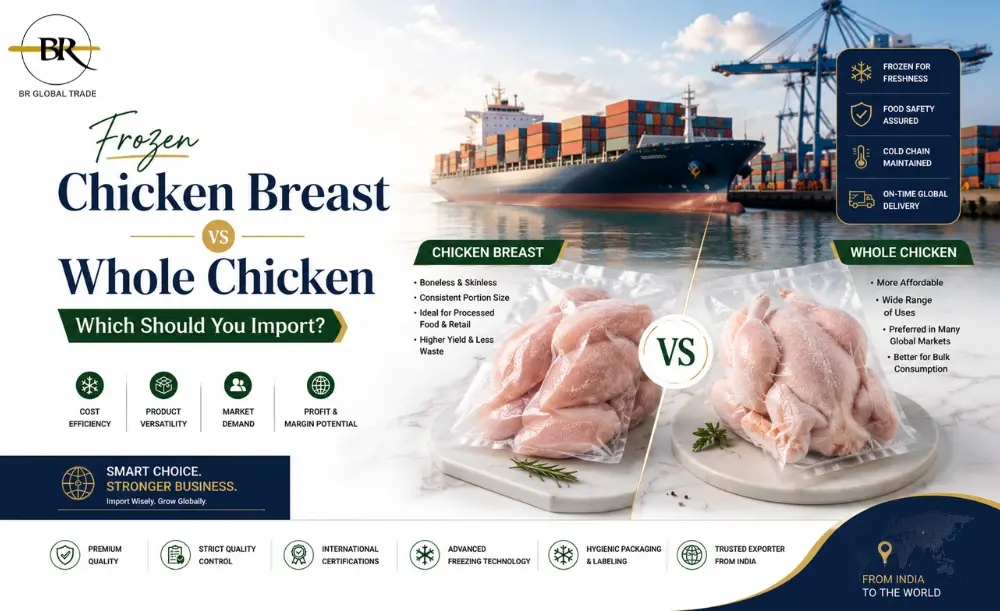

When poultry procurement strategists get ready to determine their company’s purchasing plans, it’s usual for them to use a specific version simply out of convention. However, selecting between single pieces and whole birds is not simply a technical question; it’s a choice that influences the company’s expenses, shipment density, and processing costs.
Many companies fail to correctly assess the cost implications of their decision and thus suffer due to yield losses, unneeded freight costs, and improper inventories. The decisions regarding the most profitable sourcing format depend on the company’s business model, its local labor potential, and the processing plants’ specific requirements. This guide will analyze the main factors to consider for B2B companies aiming to optimize their costs related to sourcing efforts.
Frozen Chicken Breast: Best Use Cases and Trade-Offs
If a buyer wants a consistent portion of food, frozen chicken breast is a practical option because it comes in the same weight and size every time. It is popular with fast-serve restaurants, large manufacturers of pre-cooked meals, and upscale grocery stores.
This makes it easier for businesses to prepare chicken because it comes ready for cooking. This means business owners will not need to do much prep work, and there is minimal chance of cross-contamination.
On the downside, this type of chicken is usually much more expensive than unprocessed chicken. Importers should decide whether the savings from cut prep time and not having to dispose of bones make the high price worthwhile.
Whole Chicken: Best Use Cases and Trade-Offs
Importing complete birds (grillers and roasters) provides an effective way to save money on the purchase of birds similar to those sold in traditional, open-market environments by high-volume wholesalers, open-market suppliers, and big industrial meat processing firms. Most important is the significantly lower cost of raw meat processing due to the limited degree of labor needed for complicated mechanical deboning and manual cutting of the meat in processing facilities.
The main problem is the high amount of labor needed for and specialized equipment needed for slaughtering the birds in the destination facility. Using whole birds enables maximum culinary flexibility because it allows for extracting dark meat, white meat, and wings from a single order. Therefore, whole birds are great for classic retailing industries where consumers prefer preparing whole birds or obtaining specific regional cuts of meat that have bones at lower retail rates.
Comparing Cost, Yield, and Waste Factors
To assess the actual fiscal consequences of your purchase, it’s necessary to determine the landed cost per usable kg, in addition to understanding the costs laid out in the initial invoice. The main distinction between whole birds and breast portions is that whole chicken carries significantly more non-usable weight, with bones, fat, and connective tissue making up a sizeable share of it.
In our practice of cooperating with food service buyers, we’ve noticed that the choice between breast and whole chicken often comes down to labor cost: whole chicken requires in-house cutting and deboning, which adds preparation time but comes at a lower price per kg. Breast meat costs more per kg but eliminates most of that prep work. If your operation lacks low-cost labor or efficient mechanical poultry-cutting lines, the added labor and waste-handling costs of whole chicken can outweigh the savings versus simply paying more for breast meat.
Halal Compliance and Certification Considerations
In the case of the buyers of food products for markets in the Middle East and Southeast Asia, it is imperative that they procure wholesale halal frozen chicken that has the required certifications. The importation of products by means of cross-border transactions requires the submission of sealed and valid paperwork obtained from any accredited Islamic certification bodies that supervise the slaughtering operations.
A good halal processing facility should comply with humanitarian slaughter regulations and carry out its production independently in accordance with strict health and religious standards. The absence of proper halal certification and accompanying health documents could lead to confiscation of cargo at the port of unloading, along with heavy customs fines.
Sourcing Reliability: Working With the Right Supplier
Sustaining a regular flow of inventory calls for a partner with superb cold chain logistics and extensive multi-sourcing networks. An efficient bulk frozen chicken supplier oversees the impacts of seasonal variations by ensuring steady procurement and storage practices, thereby ensuring your order lands on schedule regardless of the time of year. Since chicken meat is very susceptible to perishing, the supplier has to ensure that a cold chain environment of -18 degrees Celsius (or 0 degrees Fahrenheit) is kept during the shipment process.
Localized temperature abuse during ocean transportation leads to severe recrystallization of ice, considerable moisture loss, and extensive development of microorganisms. The solutions provided by the supplier, including the use of automated digital equipment that logs temperature enables the customer to monitor and be aware of the shipment conditions.
Questions to Ask Before Placing Your Order
Before making an international agreement on poultry import, carry out the following steps together with the supplier:
- Calibration Requirements: For the breast parts, what is the precise calibrated weight range and maximum tolerance concerning size deviations?
- Moisture Levels: What is the confirmed moisture absorption or water infusion percentage applied during the freezing process?
- Halal Certification: Which specific Halal body certifies your processing unit, and has the certification been registered at our destination port?
- Packing and Burst: What are the weight-carrying capacity and burst strength values of your secondary cartons for export?
- Traceability Charts: Are you able to provide a full lot traceability document that connects the processed box to the exact farm flock?
Choosing the Right Format for Your Business
Choosing between individual chicken pieces and whole birds requires careful consideration of your target demographic’s preferences, labor costs for local processing, and yield predictions. Focusing on all these technical factors keeps your manufacturing processes efficient and satisfies your clients with safe and regular products. If you make sure to calculate your yield costs correctly today, you will avoid expensive supply chain problems in the future.
As an India-based frozen chicken exporter, BR Global Trade supplies multi-origin frozen chicken breast and whole chicken, including certified halal options, backed by reliable bulk supply and cold chain logistics. Please contact us or write to exim@brglobaltrade.com for more information about our sourcing services.