

When acquiring raw materials for the beverage, dairy, and confectionery industries, procurement professionals depend on price lists or marketing materials. However, relying on basic marketing messages without understanding industrial methods of production can be risky and result in unexpected changes in viscosity, loss of color, and separation of enzymatic substances. Finding out how a fruit puree supplier provides and uses its product would help purchasers evaluate quality in a more applicable way.
Being aware of the ways of industrial processing will allow procurement specialists to make sure that the vendor’s claims prove true. This thorough guide depicts the main mechanical, thermal, and qualitative operations making raw fruit products valuable ingredients of international supply chains.
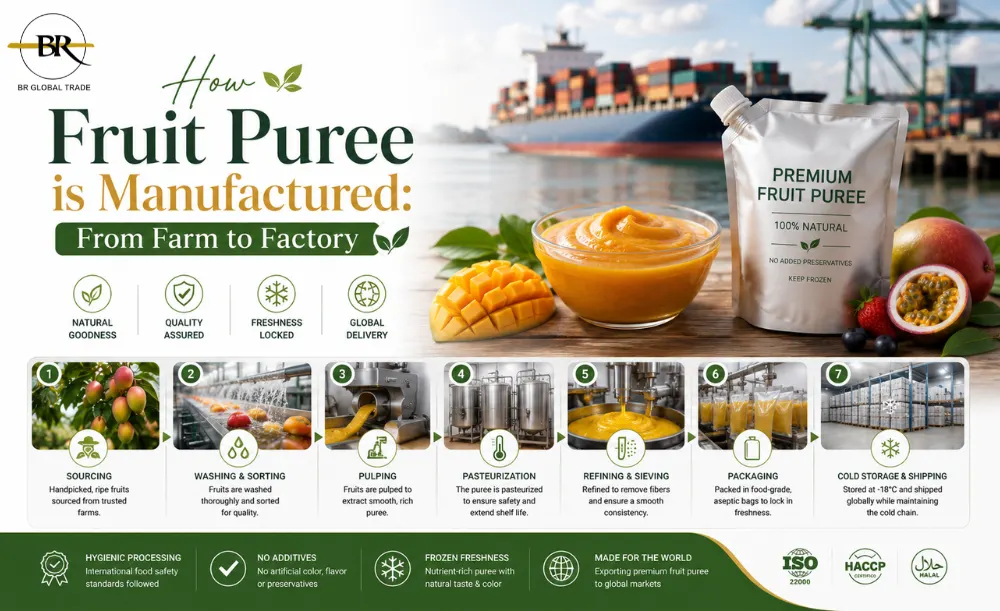
Sourcing: From Farms in India and Select Global Origins
In order to access a regular supply of good quality ingredients, contemporary sourcing methods must be implemented that help link agricultural sites with manufacturing plants. For instance, different types of fruit can be brought from agricultural zones in India or even from other countries at different times of the year.
A good example is that Alphonso and Totapuri mangoes are brought from India, and fruit of other varieties that belong to the genus of Prunus species are taken from foreign agricultural zones.
Moreover, the quality levels ensured by means of mutually beneficial associations mean that agricultural raw materials are well assessed in terms of their industrial quality regardless of their origin.
Sorting and Washing: The First Quality Checkpoint
As soon as the harvested fruit is brought to the processing facilities, it is inspected and sorted straight away. The human workers and the automated sensory grading equipment are used to check the fresh arrivals and to eliminate the under-ripe and over-ripe specimens, and to discard the ones that have suffered mechanical damage. Such a strict procedure is very important because processing any fruit at the wrong ripe stage may damage and spoil the brix-to-acid ratio in the resultant liquid.
Once graded and sorted, the fruit is subjected to a multi-step industrial washing process that uses dynamic jets of water and disinfecting baths to wash off dirt, leaves, and surface microbes. The fruit may be processed as frozen fruit puree in advance or treated fresh, but proper care at this stage is crucial for the consistency of the future product.
Pulping and Refining for Consistency
Once cleaned and sanitized, the fruits undergo mechanical extraction. This process employs precise impact and physical force to separate the juicy pulp from several non-usable components, including the hard inner seeds, tough external skins, and woody stems. It must be noted, based on industry observations, that the ripeness of the fruit at the time of pulping (in addition to the variety) has the most significant effect on Brix quality in the final product.
The next phase of pulp extraction involves filtering through high-revolution centrifugal refiners fitted with screens with mesh from 0.5mm to 1.2mm. The refining process effectively eliminates all coarse fibers, giving the product the desired consistency. The liquid is then treated in a vacuum deaerator to remove excess oxygen and thus ensure the right color of the product.
Also Read: Private Label Frozen Fruit Puree Exporter
Pasteurization and Aseptic Processing
Precision thermophysical treatment of the refined liquid is essential for ensuring full safety during consumer production. The fruit puree manufacturing process relies on precise pasteurization temperatures and aseptic filling to preserve flavor and nutrients without the addition of preservatives. The puree is subjected to treatment by a High-Temperature Short-Time (HTST) alternative heat exchanger, which allows the liquid to reach the required temperature of pasteurization, which kills the bacteria and makes the spoilage enzymes inactive.
Right after the high-temperature treatment, the puree undergoes a quick cooling process in order to avoid over-processing of the puree and preserve its flavor. The cooled puree is pumped into pre-cleaned multilayer laminated bags within a completely closed aseptic filling chamber, which helps to reduce storage costs due to the absence of deep freezing during the transport of the product.
Quality Control and Certifications
Exact laboratory tests of every batch of product processed are conducted to make sure that every batch of product corresponds to the information mentioned in the specification sheets. Special laboratories perform automated tests to determine the values of Brix, pH, acidity, and viscosity of the liquid. It is crucial to obtain the precise figures because even the smallest difference in batches may affect the way the ingredient behaves during baking or bottling processes.
In addition to physical and chemical tests, strictly conducted microbiological incubation tests use special techniques to check that the product does not contain any yeast, mold, or aerobic pathogens. To satisfy customs requirements, international quality audits examine the production with the help of internationally recognized certification systems, which ensure that the whole production process follows the standards required for safety.
Questions Buyers Can Ask About the Manufacturing Process
Prior to completing a deal for your upcoming acquisition term, safeguard your production processes by querying the supplier using the following tech checklist questions.
- What exact mesh screen sizes are employed during the final refining stage to adjust product viscosity?
- Can you provide the exact temperature-time logs from the HTST pasteurization run for this particular batch?
- How is raw agricultural Brix variation controlled to ensure consistency among multi-container orders?
- Can you give the batch traceability papers connecting the finished aseptic pouch back to the harvesting farm network?
- What specific vacuum de-aeration thresholds are kept to safeguard the puree from browning?
Partner With a Trusted Fruit Puree Supplier
Evaluating the step-by-step journey of your raw ingredients is the key to getting quality raw materials. It is important to verify these basic processing check-points to ensure the safety of your consumer recipes against the texture problems, off-flavors, and inconvenient customs port delays. This verification of processing and oversight standards is essential for your supplier’s supply chain today and in the years to come.
BR Global Trade is a prominent fruit puree exporter and supplier that ensures sourcing and quality management processes right from the time of harvesting till the fruit puree is exported from India and other countries. We take care of sourcing, quality assurance, and export logistics of fruit puree from India and other trusted origins in the world. Please reach out to us at exim@brglobaltrade.com