
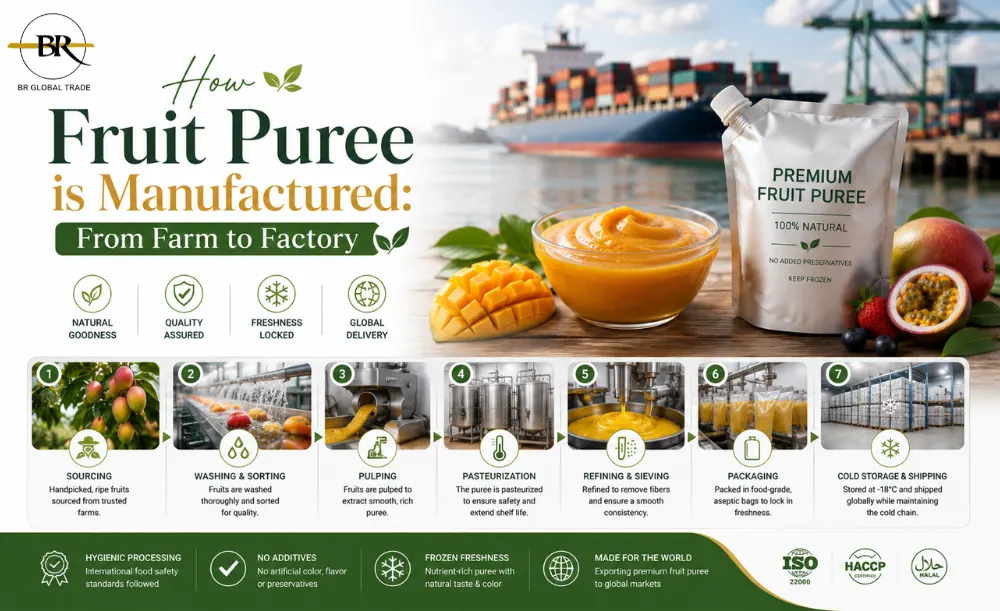

For a bulk buyer, the fruit purée manufacturing process explains why two ingredients made from the same fruit can behave differently in a recipe. Fruit maturity affects the starting material. Refining can change the amount of coarse material that reaches the pack. The processing and packing route determines which handling instructions the buyer needs. Before approving a grade, ask the supplier to show how the offered product moves from fruit intake to lot release and which records link those stages.
The sequence below describes common stages. Equipment, controls and the order of operations can vary by fruit, processor and format. Use the offered grade specification and the processor’s approved records to qualify an actual supply. Where an operation affects your recipe or receiving procedure, ask the processor which product characteristic it measures and how that result is reported to buyers.
Fruit Intake, Sorting and Preparation
At intake, processors may identify the delivery by source or intake lot and check the fruit against their receiving criteria. Maturity, damage and variety can affect the quality or characteristics of the resulting purée. Sorting helps separate material that falls outside the processor’s acceptance rules. Washing and preparation then remove surface debris and prepare the fruit for pulping. Depending on the fruit, preparation can include peeling, trimming or removing stones or seeds.
Ask which intake attributes matter for your grade and how the processor records substitutions or changes. If a specific origin or cultivar is part of your purchase specification, ask what the processor can trace and what evidence will accompany the offer. An intake record helps demonstrate the link to the source material. The exact tracing scope depends on how fruit was received and handled.
Pulping and Refining
Pulping separates usable fruit flesh from material such as skins, seeds or coarse fibres, where applicable. Refining further controls the texture and amount of coarse material that reaches the finished grade. A processor can use different equipment or screens depending on the fruit and application. Ask for the relevant output requirement on the grade specification and how it is measured. A screen aperture describes the equipment setting, while the amount of retained material describes a result from a specified test.
A smooth result in one recipe may still behave differently after dilution or during pumping. If your application depends on a particular texture, include the actual production constraint in the approval brief. Ask whether viscosity or retained particles are measured, under which conditions, and how any change in the refining arrangement is communicated. Use the beverage purée specification checklist for setting the buyer’s acceptance limits.
Processing, Filling and Storage
The offered grade should identify the processing and pack route. For aseptic supply, ask the processor how the product treatment and aseptic filling are controlled for that grade and pack. For frozen supply, confirm the pack, storage instructions and how frozen conditions will be maintained after packing. Use the processor’s validated system for the product to confirm any relevant operating limits. An operating limit for another fruit or line can reflect a different product and equipment setup.
Ask for an appropriate summary of the controls and supporting evidence. Confirm who reviews deviations, how affected lots are identified, and who can release the lot. The FAO introduction to HACCP outlines seven principles. For supplier qualification, ask how monitoring, corrective action and verification are documented for the offered line. Confirm applicable site evidence for the actual processing and packing arrangement.
| Processing Stage | Buyer Question | Evidence to Request |
|---|---|---|
| Fruit intake | What fruit and source requirements apply to the offered grade? | Grade specification and example intake trace record |
| Preparation and refining | Which controls affect coarse material or texture? | Process summary and applicable texture test basis |
| Processing and filling | How are the offered format and pack controlled? | Grade-specific pack specification and relevant validation or control summary |
| Lot release | How do pack markings connect to the production record? | Example traceability record and agreed release documents |
| Storage and dispatch | What conditions apply from packing to receipt? | Storage instructions and relevant shipment records |
Connect the Finished Pack to the Production Lot
Traceability needs to work when a shipment contains more than one production lot or when production uses more than one intake lot. Ask the supplier to demonstrate the connection from a finished pack identifier to the relevant packing and batch records. Record what can be traced upstream and how quantities are reconciled. Agree which identifiers will appear on the pack and packing list. Request the lot-specific certificate of analysis (COA) when needed and confirm which tests it will report.
Illustrative Traceability Check
A buyer receives 48 drums listed against two production lots. The packing list assigns 30 drums to Lot A and 18 to Lot B. Receiving finds 29 drums marked A, 18 marked B and one with an unreadable lot code. The count balances at 48, but one drum cannot be assigned from the markings alone. The buyer holds that drum for review and asks the supplier to reconcile it using the packing record and any unique unit identifier. The quality team records the outcome before deciding whether that drum can be released. The figures describe a hypothetical order.
Agree What the Supplier Can Share Before the First Order
Request a process summary for the offered grade and an example showing how the processor controls changes and links lots to packs. If the supplier uses a confidential record, agree whether a redacted copy, a summary or a review during an audit will answer the question. Record which items must be supplied for every shipment and which are checked during initial approval or when the process changes.
At first receipt, compare the delivered pack with the approved specifications and sample. Record any differences in closure, markings or net fill. If receiving cannot match a unit to the agreed records, identify the affected packs and follow the site’s hold procedure. A documented decision gives purchasing a specific issue to resolve with the supplier before placing a repeat order.
Confirm Changes Before Repeat Orders
Check whether the approved grade can be supplied from another site or through a different pack or refining arrangement. A new pack can change unloading requirements. A refining change can affect how the purée flows through the line. Record which changes need a document review and which need a fresh sample or line trial. For export orders, ask the exporter to confirm the proposed grade, processing partner, pack and route-specific handling as part of the offer. Browse the fruit purée and pulp range when shortlisting available grades.
FAQ
Can a Processor Blend Several Intake Lots Into One Production Batch?
A processor can combine intake lots if the approved process and purchase specification allow it. If the order requires a segregated intake lot, include the restriction in the approval record and ask how segregation is demonstrated.
What Does a Process Flow Diagram Tell a Buyer?
It shows the order of operations and where material can enter or leave the process. Ask when the diagram was last updated and whether it covers the offered line. A generic diagram can omit a step where the grade is blended or transferred.
Can a Pack Code Include Both a Production Lot and a Packing Date?
Yes. Agree which part identifies the production batch and which records the packing date. Ask for a sample code legend if the markings are unfamiliar, especially where one production batch can be packed across multiple dates.