
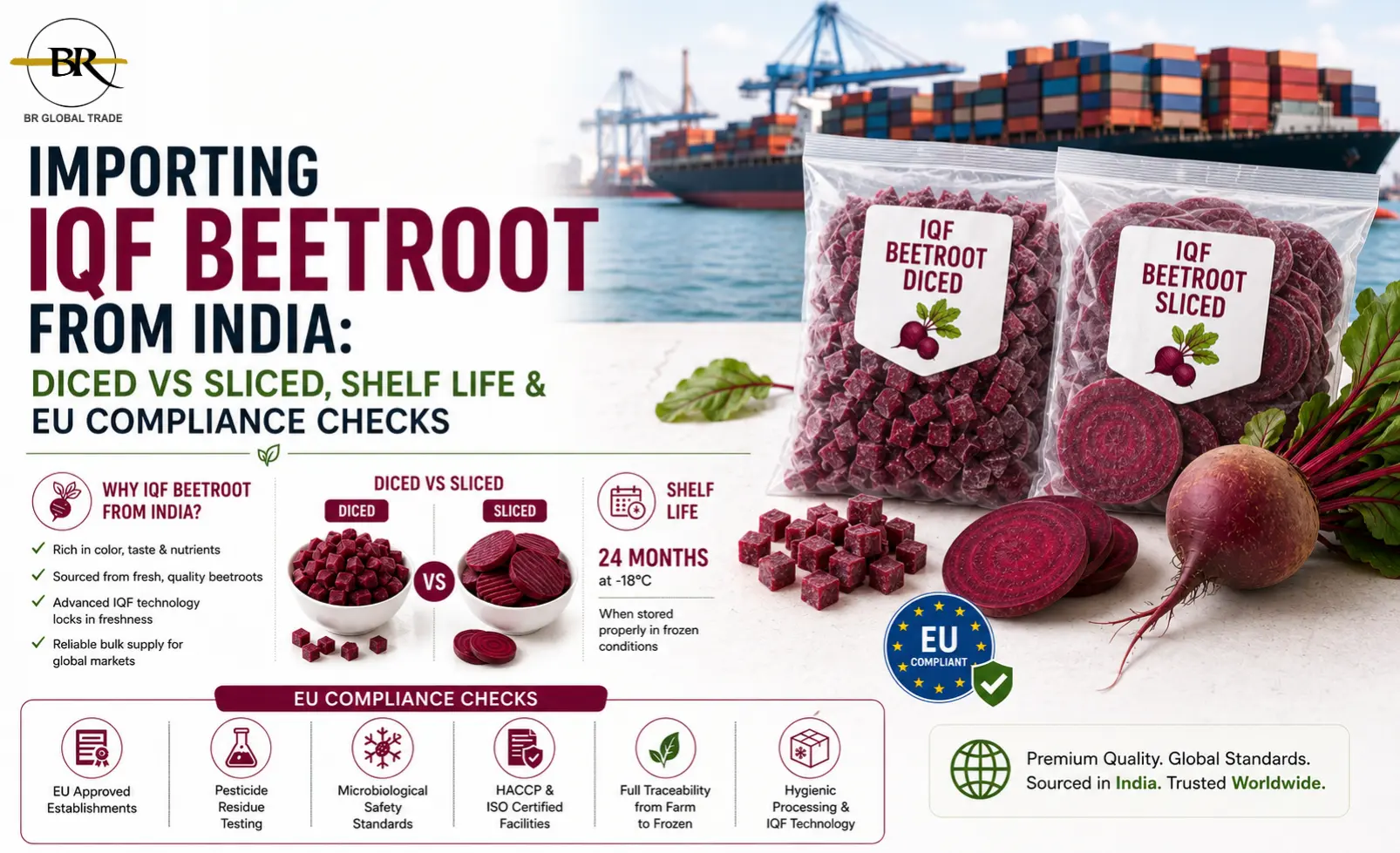

Diced vs Sliced IQF Beetroot: Which Format Fits the Application?
| Format | Format characteristics | Common applications | Buyer should confirm |
|---|---|---|---|
| Diced | Even cube-shaped pieces that support consistent distribution | Ready meals, soups, sauces, frozen mixes and HORECA production | Cut size, tolerance, piece integrity and blanching status |
| Sliced | Larger visible pieces that retain a recognisable beetroot shape | Prepared foods, retail packs, salads and suitable further processing | Slice dimensions, breakage tolerance and handling requirements |
IQF diced beetroot can suit food-manufacturing programmes where portion control and even distribution matter. IQF sliced beetroot can suit products where visible shape is important.
Buyers should not assume a standard cut size. The processing-facility specification should confirm it. Other formats, such as whole pieces, strips, julienne or customised cuts, should only be listed when availability and processing feasibility are verified.
IQF Beetroot vs Fresh Beetroot for Commercial Buyers
Choose the format around the finished application and the receiving operation. Fresh and IQF beetroot need different storage, preparation and production plans. For an IQF programme, agree the cut, processing condition, thawing or cooking instructions and the performance expected after preparation. Do not assume frozen beetroot is ready to eat or interchangeable with fresh beetroot in every process.
Compare samples under the conditions used in your facility. Check colour distribution, texture, piece integrity and the amount of handling needed before production. Review the IQF vegetable range when planning a combined ingredient order.
How IQF Freezing Helps Preserve Beetroot Quality
Codex quick-frozen vegetable standard describes rapid passage through the maximum crystallisation range. Its scope excludes products indicated for further processing or other industrial purposes; the agreed specification and applicable destination rules remain essential.
Freezing is only one part of product quality. Raw-material condition, preparation, blanching where applicable, packing and later handling can affect colour, flavour, texture, piece integrity and consistency. Avoid broad claims that IQF preserves all nutrients or guarantees overall quality unless supported by reliable, product-specific evidence.
Also Read: IQF vegetable shelf life and storage checks
What Determines the Shelf Life of Frozen Beetroot?
Use the selected facility’s validated shelf-life specification for the supplied product and pack. Confirm the production or packing date, stated storage conditions, remaining life required on arrival and the evidence needed to review a temperature deviation. A shelf-life figure from another supplier or packing format is not a substitute.
Record these requirements in the order and receiving plan. Separate production readiness, dispatch and estimated sea transit when checking whether the proposed shipment meets your minimum remaining-life requirement.
EU Compliance Checks for IQF Beetroot Imports
For IQF beetroot imports into the EU, establish the product classification, origin, processing condition and intended use with the importer before shipment. The European Commission’s import-control guidance distinguishes general food controls from products subject to specific border measures. Do not assume every frozen vegetable consignment requires identical certificates.
For EU pesticide-residue checks, identify the relevant food commodity and substances using the Commission’s MRL guidance and EU Pesticides Database. The database is an information tool; the official legal information is published in the Official Journal of the European Union. Maximum residue levels depend on the commodity and pesticide; a supplier’s general “EU compliant” statement does not identify which limits or tests were reviewed.
Agree the laboratory scope and sampling with the buyer. Ask the laboratory to identify the tested product and lot, substances covered, reporting limits, methods and results so the importer can assess the evidence against the applicable requirements. Where a result needs interpretation, resolve it with the importer and laboratory before dispatch. Also review traceability, label language, food-safety criteria and current product-origin border controls. EU guidance should not be treated as the complete rulebook for every country in Europe.
What Importers Should Verify in an IQF Beetroot Supplier
- State the required format: diced, sliced or another verified cut, together with the intended application, cut size, tolerance, piece integrity, colour expectations and defect limits.
- Include blanching status, ingredient or additive declarations, packing, private-label needs, carton or pallet requirements, quantity, destination port, Incoterm and shipment date.
- List required certificates, laboratory tests, inspection needs and CoA expectations. For bulk frozen beetroot supply, include storage and reefer requirements so the logistics plan matches the agreed product specification.
Sourcing Through BR Global Trade
BR Global Trade coordinates specification matching, packing, documentation, inspection and refrigerated logistics through processing partners. State whether you need diced or sliced beetroot, the intended application, required origin, packing, quantity and destination. Availability, supporting documents and the shipment plan are confirmed for the particular enquiry.
Conclusion
Request a specification-based bulk IQF beetroot quotation from BR Global Trade with the required cut, packing, quantity, destination and testing requirements.
Note – Regulatory references reviewed: 3 November 2026. This article provides general procurement information and is not legal or customs advice. Importers should verify current requirements for the specific product and destination.
FAQ
Should I choose diced or sliced IQF beetroot?
Choose by the finished application. Diced pieces support even distribution; sliced pieces suit products where a recognisable shape matters. Validate performance in a trial.
Is there a standard shelf life for every frozen beetroot product?
No. Request the current facility specification, supporting shelf-life validation and the minimum remaining life agreed for delivery.
Which EU documents are required?
Determine the applicable requirements for the exact product, origin and intended use. Buyer-requested certificates and official import requirements are separate checks.
Can I request private-label beetroot?
Discuss the format, pack, artwork, quantity and destination. Confirm feasibility, minimum quantities and label responsibilities before ordering.
What should an importer include in the RFQ?
Include cut and tolerance, packing, quantity, intended use, destination port, Incoterm, shipment window and required testing or documents.