
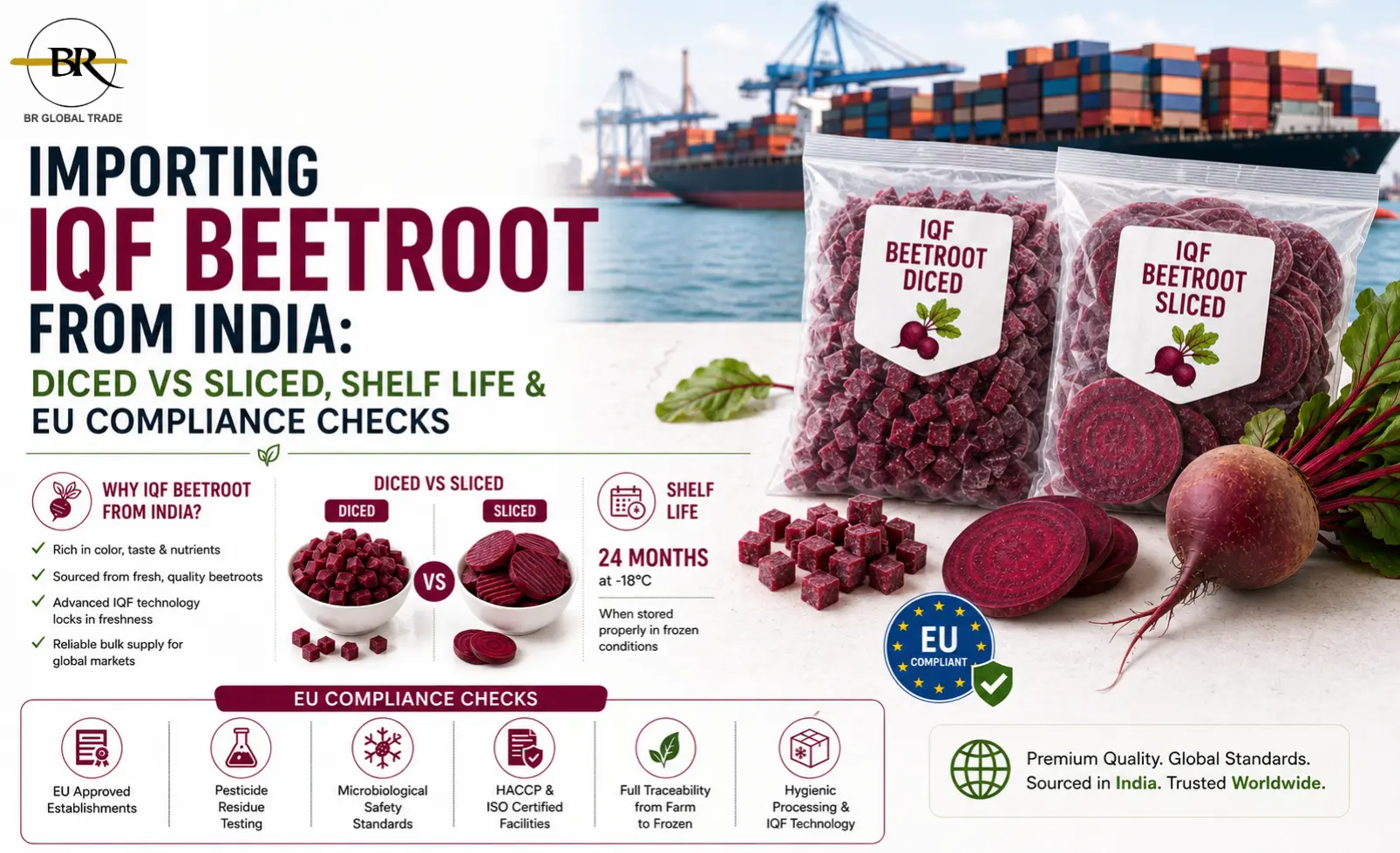

Buying bulk IQF beetroot for importers involves more than selecting a frozen vegetable. Buyers need to choose the right cut, verify the product specification and supported shelf life, and confirm destination-market requirements before ordering. Buyers evaluating IQF beetroot export from India should complete these checks before comparing quotations or placing an order. BR Global Trade operates as an exporter and sourcing partner. It coordinates specification matching, documentation, inspection and refrigerated logistics through selected processing partners.
Diced vs Sliced IQF Beetroot: Which Format Fits the Application?
Diced and sliced beetroot serve different production needs. The best format depends on how the product will be handled, mixed, packed or presented in the finished food.
| Format | Format characteristics | Common applications | Buyer should confirm |
|---|---|---|---|
| Diced | Even cube-shaped pieces that support consistent distribution | Ready meals, soups, sauces, frozen mixes and HORECA production | Cut size, tolerance, piece integrity and blanching status |
| Sliced | Larger visible pieces that retain a recognisable beetroot shape | Prepared foods, retail packs, salads and suitable further processing | Slice dimensions, breakage tolerance and handling requirements |
IQF diced beetroot can suit food-manufacturing programmes where portion control and even distribution matter. IQF sliced beetroot can suit products where visible shape is important.
Buyers should not assume a standard cut size. The processing-facility specification should confirm it. Other formats, such as whole pieces, strips, julienne or customised cuts, should only be listed when availability and processing feasibility are verified.
IQF Beetroot vs Fresh Beetroot for Commercial Buyers
When comparing IQF beetroot vs fresh beetroot, the decision is mainly commercial and operational. Fresh beetroot may suit businesses equipped to wash, peel and cut it in-house, with sufficient labour, preparation time, storage capacity and allowance for natural variability.
For many processors, a frozen pre-cut format can simplify portioning and batch planning and reduce preparation steps before production. Fresh beetroot may still be the better fit for some products.
Buyers should compare usable yield, labour needs, storage capacity, cut consistency, exposure to seasonal variation and finished-product requirements before deciding.
How IQF Freezing Helps Preserve Beetroot Quality
The IQF process freezes prepared beetroot pieces rapidly so that, when properly processed and handled, they remain individually separated instead of forming one solid frozen block. This can make the product easier to portion, mix and handle during production.
Codex CXC 8-1976 defines quick freezing as passing rapidly through the maximum ice-crystallisation range and emphasises cold-chain control through storage and transport.
Freezing is only one part of product quality. Raw-material condition, preparation, blanching where applicable, packing and later handling can affect colour, flavour, texture, piece integrity and consistency. Avoid broad claims that IQF preserves all nutrients or guarantees overall quality unless supported by reliable, product-specific evidence.
What Determines the Shelf Life of Frozen Beetroot?
The shelf life of frozen beetroot depends on the product and the conditions used for processing, packing and storage. The stated period should come from the current processing-facility specification and supporting validation, not from a general industry assumption.
Buyers should review blanching status, packaging material, seal quality, frozen-storage requirements and the supporting validation. Codex CXC 8-1976 defines quick-frozen food as maintained at -18°C or colder through the cold chain, subject to permitted tolerances; the agreed specification remains controlling.
Temperature deviations during loading, reefer transport, warehousing or distribution can affect product condition and the validated shelf life.
EU Compliance Checks for IQF Beetroot Imports
EU importers should treat compliance as consignment-specific checks. Applicable legal requirements may vary according to product classification, origin, intended use and destination. Buyer specifications and contract requirements must be confirmed separately. No exporter should promise automatic entry or blanket EU compliance.
- Check the applicable EU pesticide MRLs for the correct commodity and classification. Where required, request suitably accredited laboratory reports. Check contaminant limits against current EU contaminants legislation.
- Traceability records should connect the consignment to the relevant lot or batch, origin, processing facility and supply-chain documentation. Article 18 of Regulation (EC) No 178/2002 establishes traceability requirements across production, processing and distribution.
- Agree hygiene and microbiological requirements appropriate to the product, processing status and intended use. Universal test limits should not be assumed. Review the applicable EU food-hygiene requirements and microbiological-criteria guidance.
- A current CoA can help confirm agreed quality and laboratory parameters, but buyers should check what it covers. Labelling depends on pack type, intended market, destination language, buyer artwork and classification. Review the applicable EU mandatory food-information requirements.
- Confirm customs, tariff and destination-specific controls with the importer’s regulatory or customs adviser before shipment.
What Importers Should Verify in an IQF Beetroot Supplier
- State the required format: diced, sliced or another verified cut, together with the intended application, cut size, tolerance, piece integrity, colour expectations and defect limits.
- Include blanching status, ingredient or additive declarations, packing, private-label needs, carton or pallet requirements, quantity, destination port, Incoterm and shipment date.
- List required certificates, laboratory tests, inspection needs and CoA expectations. For bulk frozen beetroot supply, include storage and reefer requirements so the logistics plan matches the agreed product specification.
Sourcing Through BR Global Trade
For bulk IQF beetroot for importers, BR Global Trade coordinates sourcing through selected farms and processing partners. The process begins with the buyer RFQ, followed by specification matching, partner-facility confirmation, documentation and inspection coordination, and refrigerated logistics.
For companies evaluating IQF beetroot export from India, origin, testing, certification, packing and availability are confirmed against each enquiry before the order is finalised.
FAQs
What documents should an importer request?
The exact document set depends on the buyer, destination and product. It may include the agreed specification, CoA, laboratory reports, traceability records, inspection documents and shipment-specific certificates.
What information does BR Global Trade need for a quotation?
Share the required format, cut size, packing, order quantity, destination port, Incoterm, shipment date, private-label needs and required certification or testing.
Conclusion
Choose the beetroot format and confirm the key technical, shelf-life and compliance checks before comparing offers. Request a specification-based bulk IQF beetroot quotation from BR Global Trade with the required cut, packing, quantity, destination and testing requirements.
Note – Regulatory references reviewed: September 2026. This article provides general procurement information and is not legal or customs advice. Importers should verify current requirements for the specific product and destination.