

Every year, beverage manufacturers lose time and money because they specified the wrong fruit form on their purchase order. Fruit concentrate, fruit puree, and fruit pulp are not interchangeable — and the difference matters enormously to your formulation, your cold chain, and your bottom line.
Understanding fruit juice concentrate vs fruit puree is one of the first decisions procurement teams face when sourcing tropical fruit ingredients at scale. Get it right and your production line runs smoothly. Get it wrong and you are renegotiating shipping costs, redoing production runs, or fielding quality complaints.
This guide explains exactly what each form is, when to use it, and how to source the right one from India.
The Core Difference: How Each Form is Made
All three forms start with the same raw material — fresh fruit — but diverge at the processing stage, and that difference determines everything from shelf life to formulation performance.
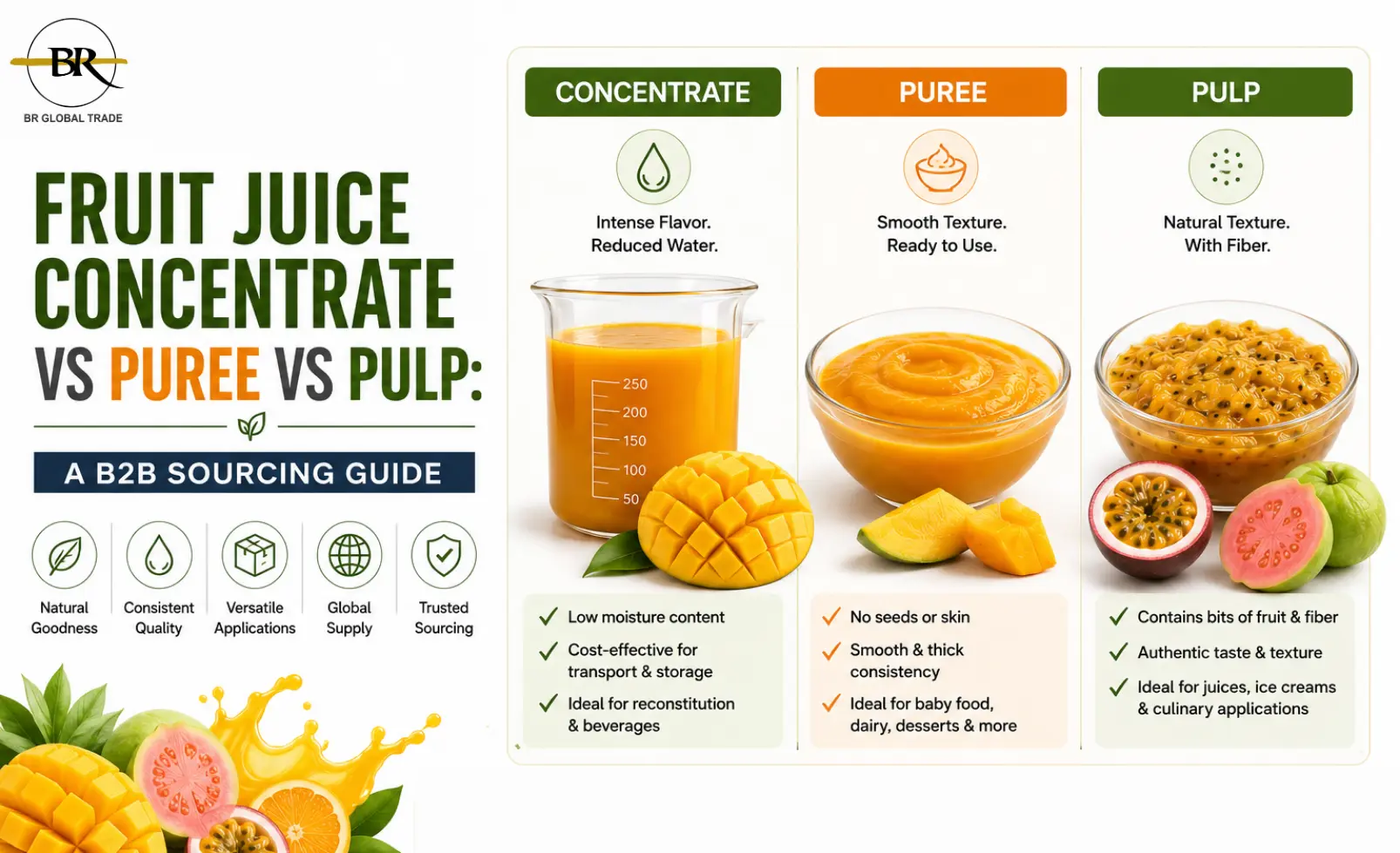
Fruit Pulp is produced by crushing fresh fruit and removing coarser fibres, leaving the product as close to its natural state as possible structure, colour, and water content largely intact.
Fruit Purée is produced by further processing the pulp, removing any remaining fibres to deliver a smooth, uniform product. Since no water is added, it has a single strength, also called NFC Not From Concentrate making it the form closest to fresh fruit.
Fruit Juice Concentrate is produced by evaporating water from juice or purée, resulting in a higher solids content, a smaller shipping footprint, and lower logistics cost per kg of usable fruit.
Think of it as a spectrum: pulp is the fruit at its most natural, purée is standardised and refined, and concentrate is the fruit at its most efficient. That spectrum maps directly onto your logistics cost, shelf life, and formulation flexibility.
The fruit juice concentrate vs fruit puree decision ultimately comes down to logistics efficiency versus ingredient freshness and the right answer depends on your production model.
Fruit Pulp vs Fruit Puree: Are They Really Different?
Here is something that surprises most buyers: in many Western markets, the terms ‘pulp’ and ‘purée’ are used interchangeably by both suppliers and procurement teams. Technically, however, they are not the same product.
Unlike purée, pulp retains more natural fibre and tissue which means texture variation between batches is expected and acceptable for some applications, but not for others.
With purée, the consistency is more uniform, making it essential when product viscosity must be repeatable. There are seeded and seedless variants across some purée types this should be confirmed at the ordering stage, not afterwards.
If your production line uses automated dosing and requires repeatable viscosity batch to batch, specify purée the consistency it delivers is essential for line performance. If a slight texture deviation is acceptable, pulp may offer a better price-to-quality ratio.
When to Use Fruit Concentrate in Food Manufacturing
Concentrate typically wins the specification decision when distance, shelf stability, and production volume are the dominant procurement factors.
- When Producing Beverages at Scale, concentrate allows you to reduce logistics overhead by 60–70% compared to single-strength juice or purée — a significant factor when shipments cross continents.
- When Shelf Life Is an Essential Factor, aseptically packed concentrate does not require cold storage, remaining shelf-stable for extended periods — a clear advantage for long-haul international supply.
- When Flavour Consistency Is Required, a consistent solids concentration makes it easier to standardise flavour dosing across large production batches.
- When Cost Efficiency Is a Priority, concentrate typically delivers a lower cost per unit of usable flavour output than purée of equivalent strength.
- When Cold Chain Is Not Guaranteed, aseptic concentrate operates without the refrigeration constraints that purée requires throughout the supply journey.
Shipping tropical fruit juice concentrate from India to Europe or North America is a clear example of when concentrate outperforms purée on both logistics cost and supply reliability.
When to Use Fruit Puree (and When Not To)
Purée finds its way into products where texture, freshness, and label claims matter more than logistics efficiency.
- For premium beverages and functional drinks, purée provides the natural mouthfeel and fresh fruit character that concentrate cannot replicate.
- In baby food formulations, NFC purée is widely specified — the natural texture and clean-label status meet the sourcing requirements of most major infant nutrition brands.
- In dairy applications, ice cream, yoghurt, and desserts benefit from the fruit body and texture that purée delivers.
- For clean-label product development, “Made with real fruit purée” carries genuine value for retail buyers and consumer-facing brands alike.
- In R&D and NPD trials, purée gives formulation teams a closer-to-fresh starting point for testing market-responsive products.
Do not specify purée when your facility requires ambient storage, when the shipping route lacks cold-chain infrastructure, or when high-volume production demands tight cost control concentrate is the better procurement decision in all three scenarios.
Choosing the Right Form for Your Industry — Quick Reference
Typically, beverage and juice manufacturers prefer concentrate for scalability and shelf life, while purée is the specification for premium or not-from-concentrate (NFC) ranges.
In dairy processing, purée is preferred for premium beverage formulations and frozen dairy manufacturing, while concentrate suits flavoured drink bases and beverage blends. Baby food manufacturers specify purée in almost all cases — but confirm brand-specific sourcing guidelines before placing an order.
In bakery and confectionery, purée is typically used for fillings and texture, while concentrate is chosen for coatings and syrups. For FMCG and ready-to-eat formulations, liaise with your R&D team to match the fruit form to consumer positioning and shelf life requirements.
Sourcing Fruit Puree and Concentrate from India: What to Expect
India is an established sourcing origin for tropical fruit ingredients, with APEDA-regulated export infrastructure and year-round availability across a wide range of varieties. Mango (Totapuri and Alphonso), pineapple, guava (both pink and white), banana, papaya, passion fruit, pomegranate, lemon, and tamarind are regularly exported in both purée and concentrate forms.
Before finalising any supplier, verify certifications — HACCP and ISO 22000 at minimum — and request a certificate of analysis and phytosanitary certificate upfront.
Confirm packaging formats with your supplier — aseptic bags, drums, and IBC totes are standard. Established suppliers typically offer sample quantities for evaluation before you commit to a full order.
As an established fruit juice concentrate suppliers from India, BR Global Trade supplies aseptic and frozen formats across all the tropical varieties listed above.
It is also important to note that many tropical fruits are not grown at large scales in India. For instance, many suppliers source passion fruit and other tropical fruits from Vietnam and Southeast Asia.
The Bottom Line — Concentrate, Puree, or Pulp?
The fruit juice concentrate vs fruit puree choice depends on your production model, your cold-chain capability, and your product positioning. Concentrate wins on efficiency and scale; purée wins on texture and premium positioning; pulp works where natural variation is tolerable and cost matters more than uniformity.
India remains a credible and well-established sourcing origin for all three forms — but confirm the exact growing region for each specific fruit rather than relying on assumptions.
Ready to specify the right form for your next production run? Contact BR Global Trade’s export team — your trusted fruit puree concentrate supplier from India — to request a product catalogue, Certificate of Analysis, or arrange sample shipments of any tropical concentrate or purée variety.
For a full walkthrough of the sourcing process, visit our Sourcing Guide. Or explore our Mango Purée Concentrate product page for bulk purchase specifications.